 Contact Us Today
 Begin My Assessment
 Watch Us On Youtube
 enquiries@spineconnection.org
Two patterns come up more than any others:



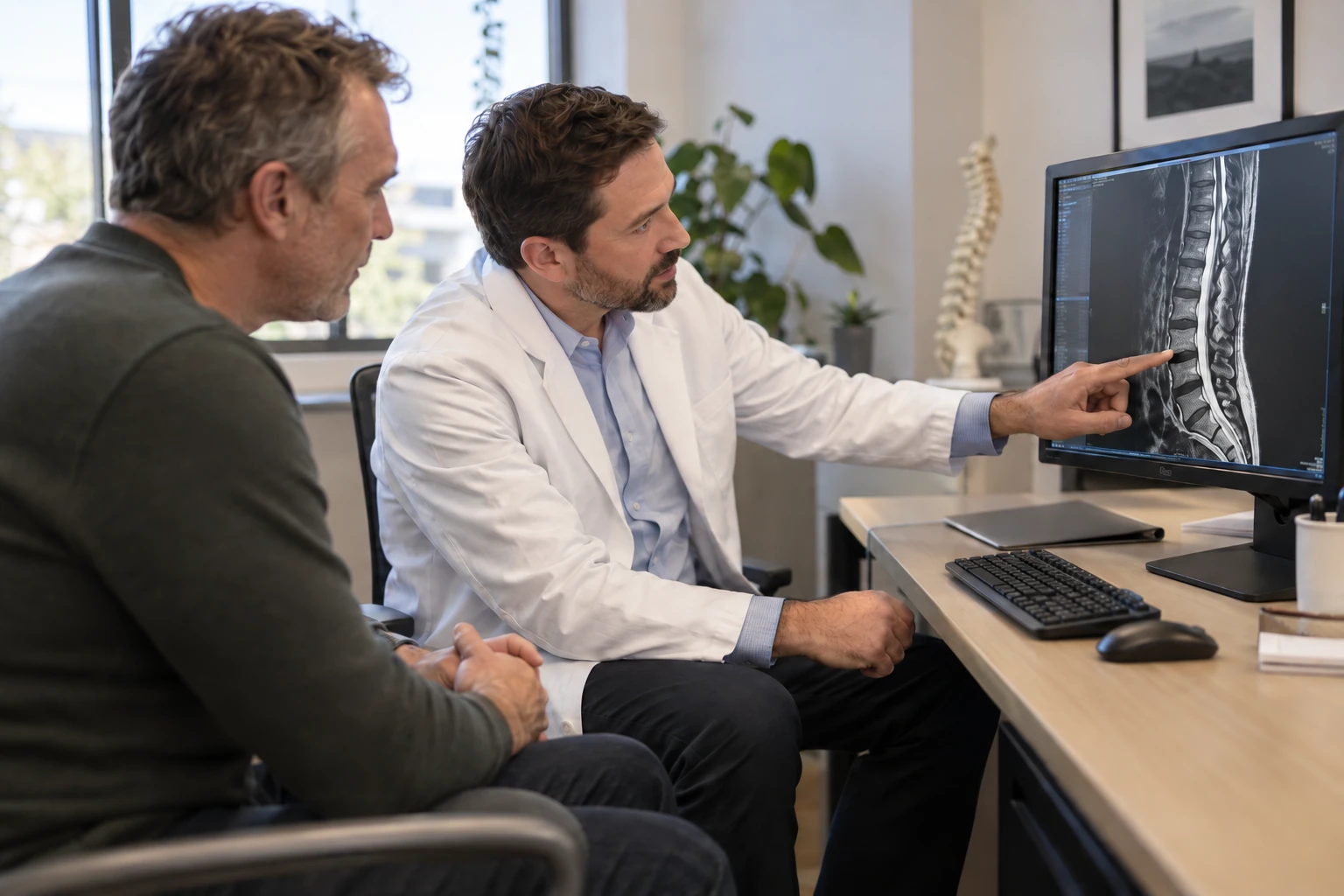
Failed back surgery is pain that continues, or comes back, after spine surgery that was meant to relieve it. It is also called persistent pain after surgery, or, in medical terms, persistent spinal pain syndrome. The name is misleading. In most cases the surgery did what it was meant to do; the problem is that it did not fully relieve the pain, or a new problem developed afterwards. It is more common than most people expect, affecting somewhere between 10 and 40% of people after spine surgery, and the pain is often nerve-related (neuropathic) rather than purely mechanical.
The most important thing to understand is that failed back surgery is not a single condition. It is a description of an outcome that can have several different causes, and the right way forward depends entirely on which one is behind your pain. That is why a careful re-diagnosis matters more here than almost anywhere else in spine care.
The pain may be a continuation of what you had before surgery, a return of it after a pain-free spell, or a new pain that appeared afterwards. It is often felt in the back, the leg, or both, and it frequently has a nerve quality: burning, shooting, tingling, or numbness rather than a simple ache. The timing is a useful clue, because pain that never improved at all usually points to a different cause than pain that eased for weeks or months and then returned.
Some symptoms need urgent attention rather than watchful waiting: new or worsening weakness in a leg, a foot that begins to drag, or any loss of bladder or bowel control.
Some pain in the first weeks after spine surgery is normal and expected, and knowing what is ordinary recovery saves a great deal of worry. Wound and muscle pain usually settles over a few weeks. Nerve pain is slower: a nerve that has been compressed for a long time can take many months to recover, and numbness and pins and needles are often the last symptoms to improve. After a fusion, some discomfort is common for months while the bone knits and the muscles recover.
What matters most is the direction of travel. Pain that is gradually easing, even slowly, is usually recovery doing its job. Pain that never improved at all, or that eased for weeks or months and then returned, is the pattern worth investigating, and that is what the rest of this page is about. Weakness that is worsening rather than improving is different again and should be assessed promptly.
Because it is an outcome rather than a single disease, there are several possible causes, and identifying the specific one is the whole task:
Diagnosis is the most important step, because the cause determines the treatment, and it is worth taking time to get right. It begins with a detailed history, in particular whether the first operation helped at all and what changed, and a careful examination. Imaging is then chosen to answer specific questions: an MRI, often with contrast, can tell scar tissue apart from a recurrent disc; a CT scan shows whether a fusion has healed solidly and whether any hardware is well placed; and flexion-and-extension X-rays show whether a segment is moving abnormally. Targeted diagnostic injections can help confirm exactly which structure is producing the pain. The aim is a precise answer to a single question: what, specifically, is causing this pain now?
The right treatment follows directly from the cause, and more surgery is not automatically the answer.
1. Pain management and rehabilitation: for many people, and especially where no clear structural target is found, the best results come from a structured programme of physiotherapy, medication, and targeted injections rather than another operation.
2. Spinal cord stimulation: where the pain is mainly neuropathic and there is no correctable structural cause, a spinal cord stimulator, a small implanted device that alters the pain signals reaching the brain, is an established option, and in trials it has compared well against repeat surgery for this kind of pain.
3. Revision surgery: where there is a clear, correctable structural cause, such as a recurrent disc, an unstable segment, a nerve that was never fully freed, a fusion that did not heal, or adjacent segment disease, a well-planned second operation can work. But the reverse is also true: operating again without a clear target tends to help less, and the evidence shows success rates fall with each further operation, so identifying a specific, fixable cause always comes first. Where adjacent segment disease above a fusion is the problem, a motion-preserving option such as disc replacement at the new level may be preferable to simply extending the fusion.
Patients reach us after a first, a second, sometimes a third operation, often having been told little more than that the surgery failed. Our starting point is never to assume that more surgery is the answer. It is to work out precisely why the pain is still there, because that is what decides whether the right next step is rehabilitation, a stimulator, or a carefully targeted second operation.
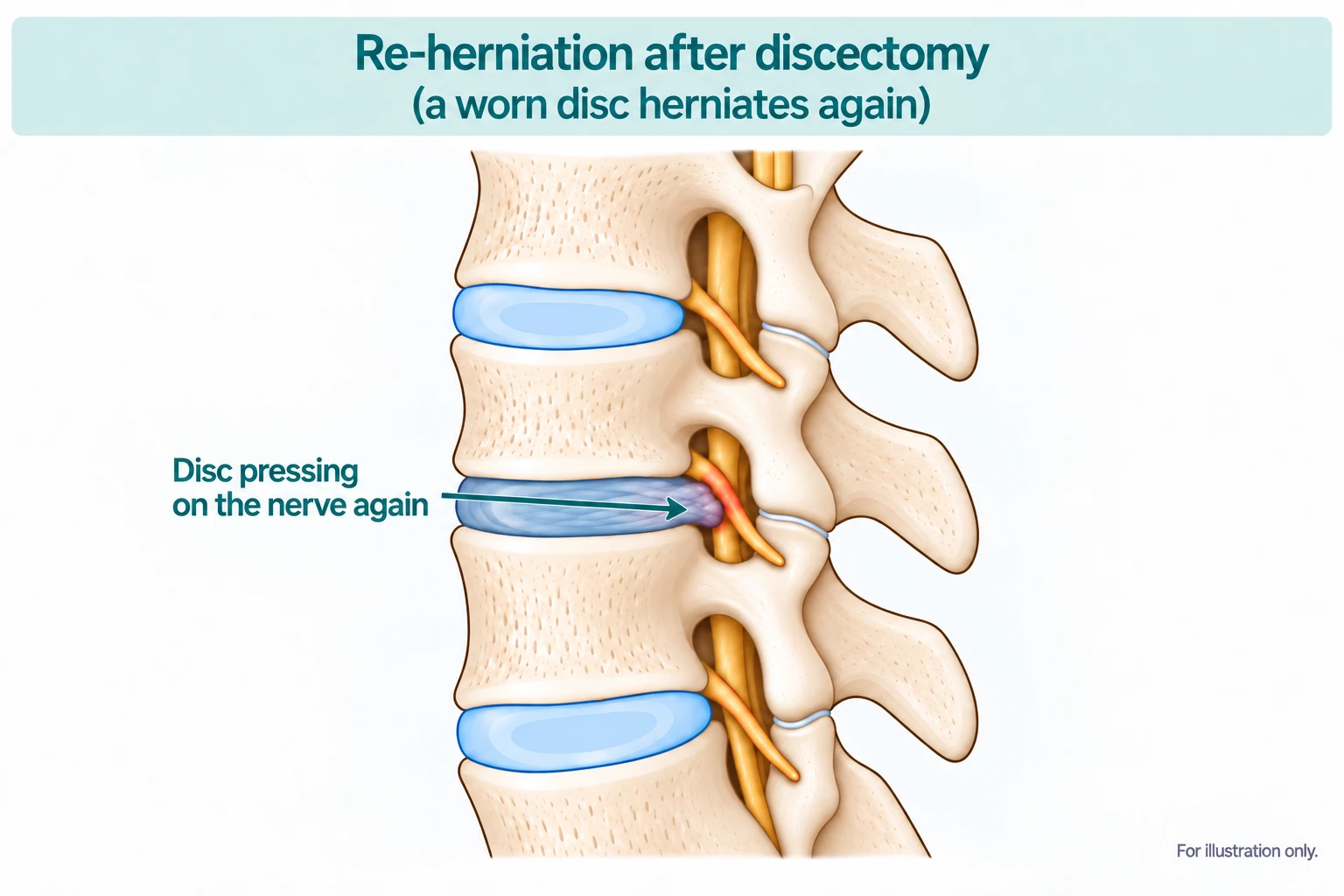
Two patterns come up more than any others:
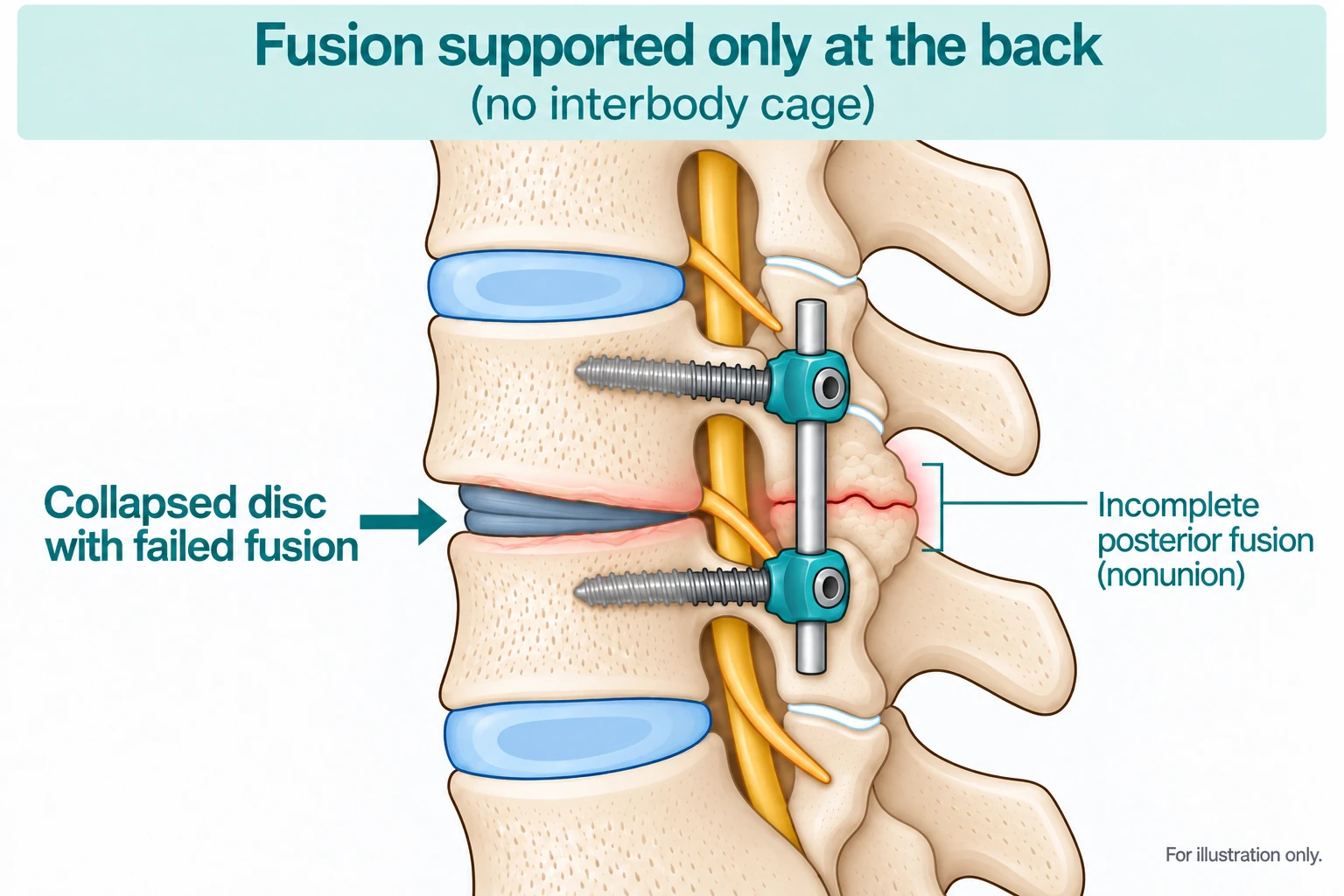
That was held together with posterior rods and screws but with no cage placed in the disc space to support the front of the spine. The front of the spine carries most of the load, so without that support the bones often fail to fuse solidly, the hardware can loosen, and the pain returns.
Performed on a disc that was unlikely to hold up: one that was already badly degenerated or unstable, or that had a large tear in its wall, where removing more disc was always more likely to end in a recurrence than in lasting relief. Both are usually clear once the imaging is reviewed properly, and each points to what a corrective operation needs to do.
Dr. Chaidej Sasomboon is an orthopedic spine surgeon and Deputy Medical Director at Bangkok International Hospital. He completed two fellowships in the United States, in minimally invasive spine surgery at UCSF and in complex and deformity spine surgery at Columbia University in New York, and he specialises in revision surgery: re-operating on and correcting previous spinal procedures that have not worked, using image-guided navigation for accuracy. His stated approach is to tailor each operation to the individual rather than fit the patient to a standard template, which is exactly what a revision case calls for.
Some pain in the first weeks is normal and expected. Wound and muscle pain usually settles over a few weeks. Nerve pain is slower: a nerve that has been compressed for a long time can take many months to recover, and pins and needles or numbness often improve last. What matters is the direction of travel. Pain that is gradually easing is usually recovery. Pain that never improved, or that returned after a good spell, is worth investigating.
Some discomfort in the months after a fusion is common while the bone knits and the muscles recover. Pain that persists well beyond that, or that returns after a pain-free period, is not something to simply accept. It may mean the fusion has not healed solidly, that a neighboring level is now taking extra load, or that the original operation did not address the true source of the pain.
Longer than most people expect. Nerve recovery is measured in months rather than weeks, and improvement often continues for a year or more, particularly where the nerve was compressed for a long time before surgery. Numbness and pins and needles tend to be the last symptoms to settle. Weakness that is worsening rather than improving is different, and should be assessed promptly.
There are several possible causes and identifying which one applies is the whole task. The surgery may have treated a level that was not the true source, or not fully freed the nerve. A disc can herniate again. Scar tissue can tether a nerve root. A segment can be left unstable, a fusion may not have healed, or the levels next to a fusion can wear in turn. Sometimes a nerve keeps sending pain signals after the pressure has been relieved.
Scar tissue around a nerve root after surgery is normal and does not disappear. In most people it causes no trouble at all. Occasionally it tethers or presses on the nerve and becomes a source of pain in its own right. It is one of the things an MRI with contrast is used to tell apart from a recurrent disc, because the two need very different treatment.
Usually not, and the name is misleading. In most cases the operation did what it was intended to do; the problem is that it did not fully relieve the pain, or a new problem developed afterwards. The field increasingly uses the term persistent spinal pain syndrome for exactly this reason. It affects somewhere between 10 and 40 percent of people after spine surgery.
Only where there is a clear, correctable structural cause, such as a recurrent disc, an unstable segment, a nerve that was never fully freed, a fusion that did not heal, or wear at the level next to a fusion. Operating again without a clear target tends to help less, and success rates fall with each further operation. Where the pain is mainly nerve-related with no correctable cause, spinal cord stimulation and a structured rehabilitation program are established alternatives.
If you are still in pain after spine surgery and have been left without a clear explanation, a second opinion focused on why can change everything. Our specialists in Thailand and Germany can review your history and imaging, work out what is actually driving the pain, and tell you honestly whether the answer is rehabilitation and pain management, a spinal cord stimulator, or a carefully targeted revision, or whether a further operation is unlikely to help.
