Contact Us Today
 Begin My Assessment
 Watch Us On Youtube
 enquiries@spineconnection.org


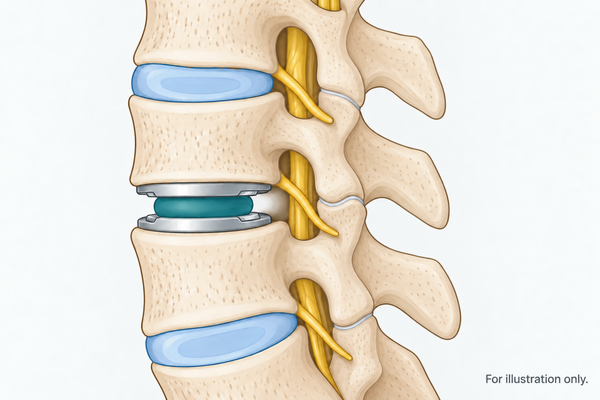
Also called total disc replacement, this removes the worn disc and replaces it with an implant that preserves movement at that level. Several motion-preserving implants are used at our German centre, and they differ in design: the ProDisc-L uses a fixed ball-and-socket bearing; the activL has a mobile core that allows a small amount of controlled gliding as well as rotation; the Baguera-L can be fitted with either a mobile or a fixed core; and the LP-ESP is a one-piece viscoelastic disc that also absorbs shock. Each is supported by published clinical evidence of reduced pain and improved function, with long-term follow-up of five years and beyond for several of them. The right implant depends on your anatomy and the details of your case rather than on any one device being better, and that match is made at assessment. Long-term studies have also found comparable results whether one or two levels are treated, with replacement across three or more levels reserved for selected cases. Because movement is preserved rather than removed, studies have found that disc replacement is associated with less wear on the neighbouring segments than fusion, though it is not suitable for everyone, so careful patient selection is what makes the difference.
Many people with disc degeneration have no symptoms at all. When it does cause symptoms, the usual pattern is lower back pain, or neck pain if the affected discs are higher up, that tends to be worse with sitting, bending, or lifting, and often eases with walking or a change of position. It commonly occurs in flare-ups lasting days to weeks that then settle, rather than as constant pain.
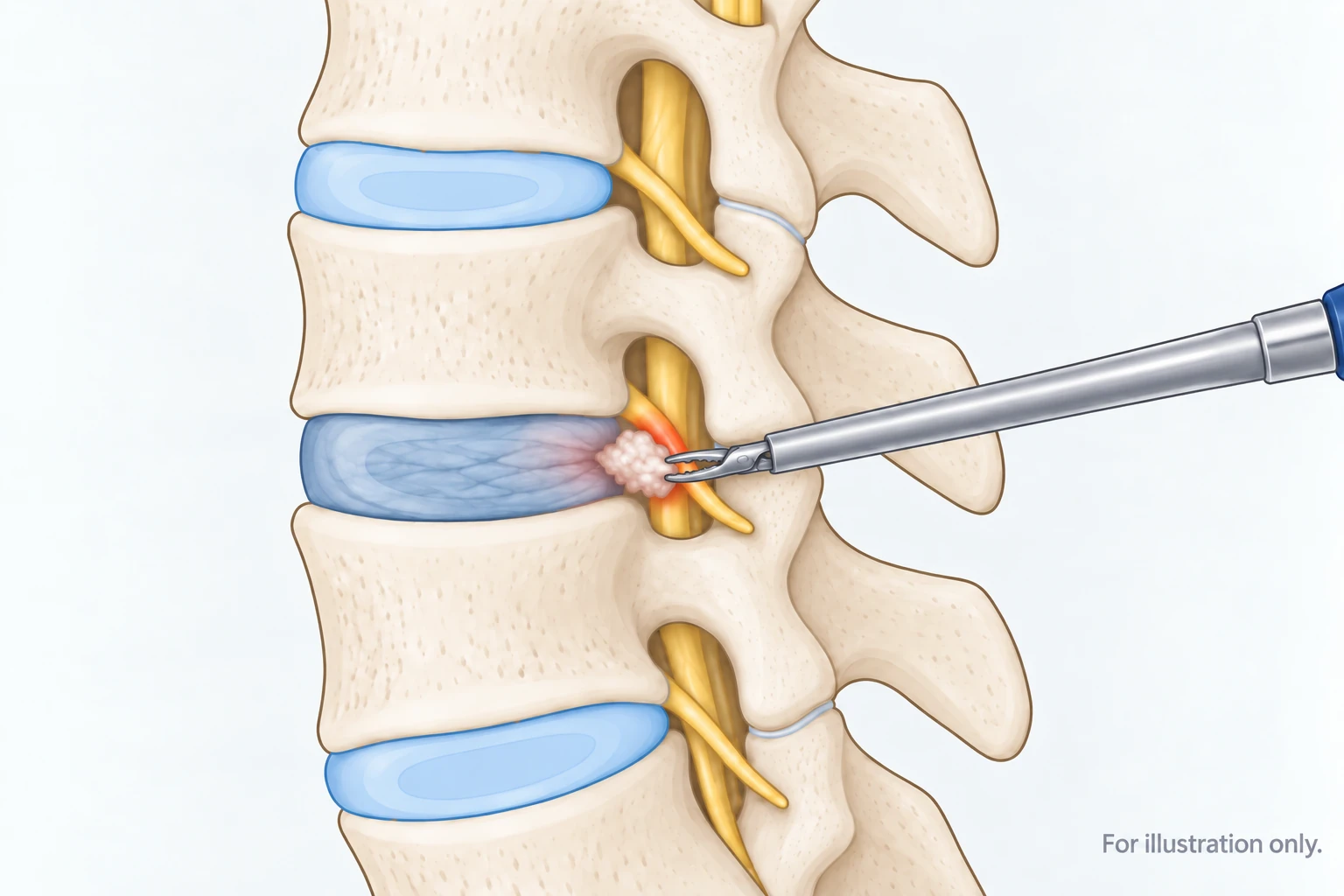
If a worn or bulging disc presses on a nearby nerve, pain, numbness, or weakness can travel into the buttock and leg (sciatica), or from the neck into the arm. This radiating pain is often what brings people in.
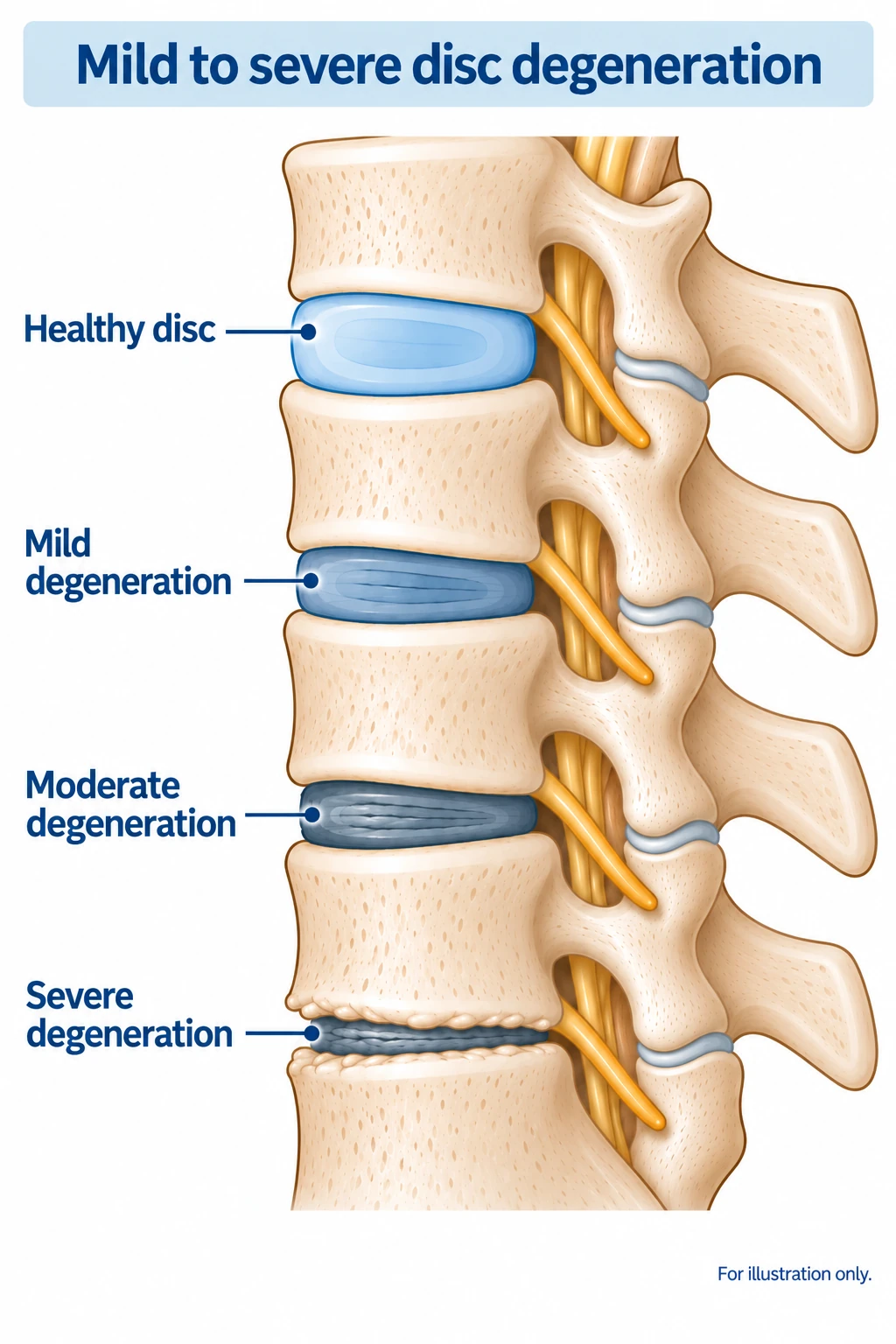
Degeneration often progresses through phases: an early phase in which small tears and inflammation cause pain, a middle phase in which the segment becomes less stable, and a later phase in which the body stiffens the segment and symptoms often settle. Symptoms can therefore change over years, and many people improve without surgery.