Cover Top Placeholder

Facet Arthropathy

Cover Middle Accent
Cover Bottom Height Engine
Last updated:

What is facet arthropathy?

Facet arthropathy is arthritis of the facet joints, which are the small paired joints at the back of each level of the spine. Their role is to guide movement and stop you from bending or twisting too far. You may also see this written as facet arthrosis, facet joint osteoarthritis, facet hypertrophy, facet degeneration or facet arthritis, which all describe the same joint wear. When these joints wear down, they can become a source of ongoing lower back pain and stiffness. It is one of the most common causes of chronic low back pain, and for most people it can be managed without surgery.

At the front of each spinal level, the vertebrae rest on a cushioning disc. At the back, the two facet joints interlock with the level below. In a healthy spine the disc and the facet joints share the load and move together. When that balance is lost, the facet joints carry more strain than they are built for, and over time the cartilage wears, the joint capsule thickens, and the joint can become painful.
Using controlled diagnostic injections, the facet joints are estimated to be the source of pain in roughly 15% to 45% of people with chronic low back pain, and this rises with age.

One distinction that is worth knowing: Facet arthropathy is the finding a doctor sees on your scan or examination. Facet joint syndrome is the set of symptoms that wear produces. Not all cases of facet arthropathy are symptomatic and cause pain.
Patient Education Video

What does facet arthropathy feel like?

Facet arthropathy usually causes lower back pain that is worse when you lean backwards, twist, or stand for a while, and tends to ease when you sit or lean forwards. The pain is usually felt locally, or spreads into the buttock or thigh, rather than travelling down the leg past the knee the way sciatica does. Many people notice it most as stiffness in the morning or after sitting still.

No single symptom, and no scan on its own, reliably confirms that the facet joints are the cause. Wear on the facet joints appears on the scans of many people who have no pain, and examination and imaging correlate poorly with the pain itself, so the diagnosis usually requires targeted injections to identify the facet joints as the ‘pain generator’.

What causes facet arthropathy?

The most common cause is age-related wear, the same osteoarthritic process seen in other joints, and it becomes more common as people get older. A few things make it more likely or speed it up:

  • Disc degeneration at the same level. Facet arthropathy is frequently a consequence of disc problems. As the disc in front loses height, more load transfers onto the facet joints behind it, and instead of gliding, they can become misaligned, inflamed and arthritic as a result. This changes how the condition is treated, which is covered below.
  • Previous injury, including small fractures or damage to the cartilage.
  • Inflammatory arthritis such as ankylosing spondylitis, rheumatoid arthritis, or psoriatic arthritis, because the facet joints are synovial joints and can be affected like any other.

We regularly observe damaged discs presenting with facet damage at the same level.

How is facet arthropathy diagnosed?

Imaging (X-ray, CT, or MRI) can show wear on the facet joints, but studies have consistently found that examination and imaging correlate poorly with the pain, and that joint wear is common on the scans of people without symptoms. A scan cannot confirm on its own that the joints are the pain source.

The most reliable test is a medial branch block: local anaesthetic is placed on the small nerves that carry pain from a specific facet joint. If it removes a high proportion of the pain, usually 80% or more, it points to that joint as the pain source. Because a single block has a high false-positive rate, it is often repeated on a second occasion to confirm before any surgery is considered.

How is facet arthropathy graded?

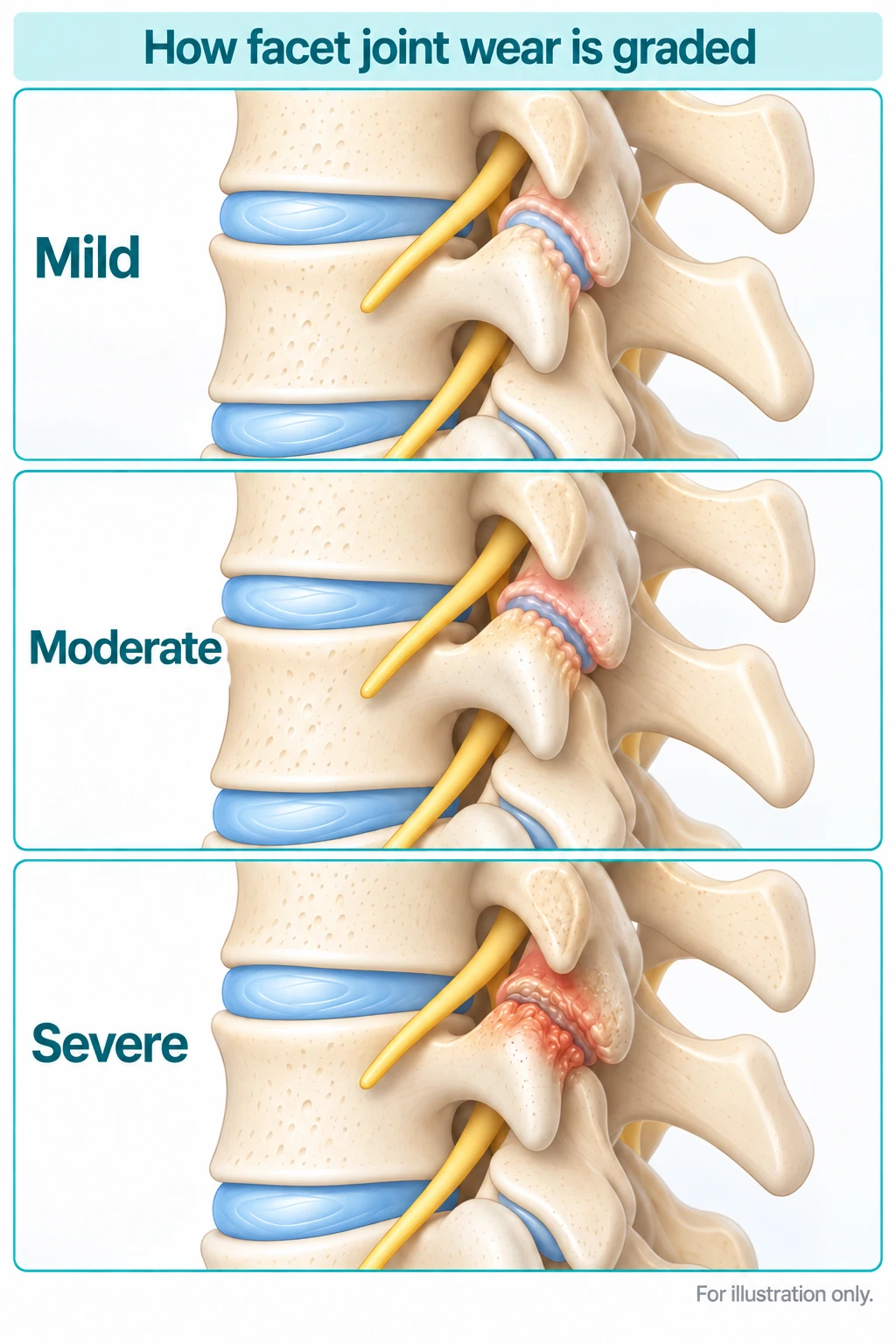
Facet joint wear is graded on scans from mild to severe, and these are usually the words that appear on your report. The same caution from diagnosis applies: the grade on a scan does not predict how much pain a person may have.

Mild: the cartilage lining the joint begins to thin and the joint may become inflamed. Pain, if any, is usually intermittent.

Moderate: the cartilage wears further, the joint space narrows, and small bony growths (osteophytes) form as the joint tries to spread the load. Stiffness and pain become more consistent.

Severe: the joint is markedly worn and enlarged, which can crowd the nearby nerves and, combined with disc height loss, contribute to stenosis or instability.

Radiologists commonly use a four-grade scale running from normal through mild and moderate to severe, and different centres grade slightly differently, so the same spine can be described in more than one way.

Two other words often appear alongside the grade. Bilateral means both facet joints at that level are affected rather than one side. A facet joints come in pairs, this is common and expected. Multilevel means more than one level of the spine shows wear, for example L4/L5 and L5/S1 together.

Because imaging and pain match so poorly, the grade matters less than whether a diagnostic block confirms the joint as the source. Someone with mild-looking wear can have significant pain, and someone with advanced wear can have none.

How is facet arthropathy treated?

Most facet arthropathy is managed without surgery. Treatment usually works up a ladder, starting with the simplest options and moving on only if pain persists.

  1. Conservative care (first line). Staying active within comfortable limits, targeted physiotherapy to strengthen the muscles that support the spine, avoiding the movements that flare it up, and anti-inflammatory medication where appropriate. Many people need nothing more than this.
  2. Injections and radiofrequency ablation. If the pain is confirmed to come from the facet joints, radiofrequency ablation, also called neurotomy, uses heat to interrupt the small nerves carrying pain from the joint. In carefully selected patients, confirmed by diagnostic blocks, it can give months of relief, and it is regarded as the mainstay interventional treatment for confirmed facet pain. The evidence here is mixed, though: some trials show clear benefit and others little advantage over a sham procedure, so careful patient selection matters. Steroid injections into the joint itself have a weaker and more variable record.
  3. Regenerative treatment. Stem cell & Exosome injections into the joint is considered experimental, with limited long-term evidence. Some patients may try this before considering surgery, and some achieve positive results. This is an emerging field in medicine.
  4. Surgery. Surgery is considered only when conservative options are exhausted and there is a clear structural cause, particularly where there is nerve compression, instability, or associated stenosis. What kind of surgery is appropriate depends on why the joint is painful.

What are the surgery options for facet arthropathy?

When facet arthropathy needs surgery, the right procedure depends on what is driving the pain. In many patients the facet joints have worn because the disc in front of them has lost height and transferred extra load onto them, which means the facet arthropathy is a consequence of disc degeneration rather than a problem on its own. The main options are:

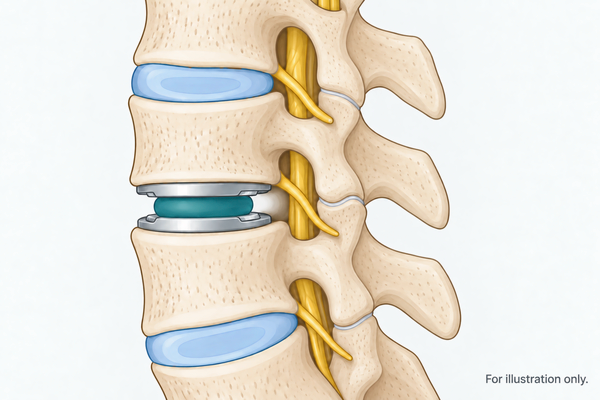
1. Artificial Disc Replacement (ADR)

Where a collapsing disc is the driver, restoring the disc height with an artificial disc replacement can take the load off the facet joints. Because the facet joints have their own blood supply, relieving that abnormal loading can, in selected cases, allow the joint to settle rather than being treated directly. This is not appropriate for cases of Disc Degeneration where the Facet Arthropathy has become severe and beyond rehabilitation.

2. Facet Joint Replacement (TOPS)

Where the facet joints themselves are the main problem and are too worn to preserve, they can be removed and their function replaced with a dedicated facet joint replacement. The TOPS System is a mechanical implant that takes over the stabilising role of the facet joints, after the worn joints and the tissue pressing on the nerves have been removed. The implant allows the segment to keep moving in flexion, extension, side bending, vertical compression and rotation. It is used in place of a fusion at that level, most often where worn facet joints are combined with nerve compression and a small amount of instability. The TOPS System has been used by our German centre for over 13+ years now.

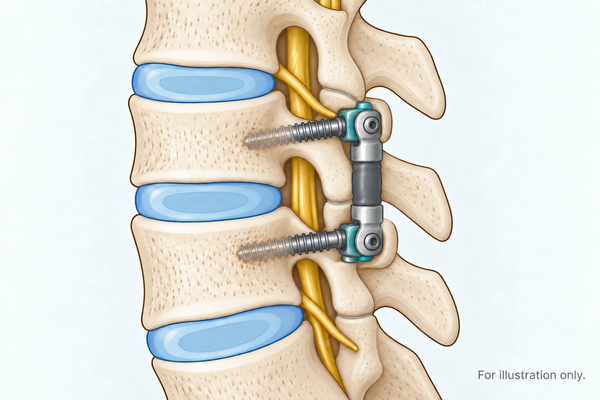
3. Dynamic Stabilisation (HPS 2.0)

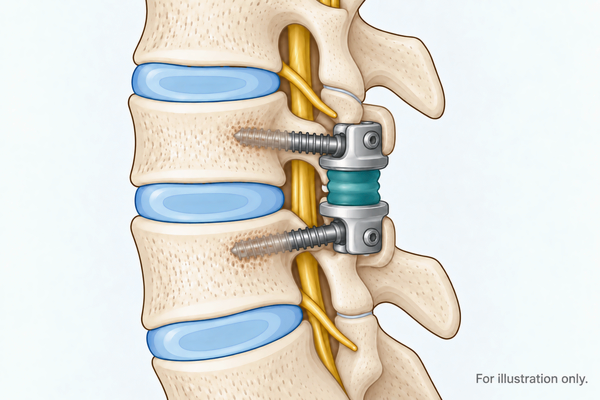
Where the facet joint itself is the primary problem and the segment needs support, a dynamic stabilisation system holds the segment while keeping it moving, instead of fusing the level. The aim is to preserve motion while reducing the extra load that a fusion transfers to the neighbouring segments. Our German specialists use the HPS 2.0 system as one solution. It is fixed with titanium pedicle screws and uses a titanium-alloy dynamic coupler that allows controlled flexion, extension, and side bending. Where the facet joint can be preserved, the system supports it, and where the joints are too damaged, part or all of them can be removed during the same operation and its stabilising role taken over by the implant. Two resistance models let the surgeon match it to your anatomy, it can be used across more than one level, and because it is smaller than earlier-generation systems it requires less bone to be removed.

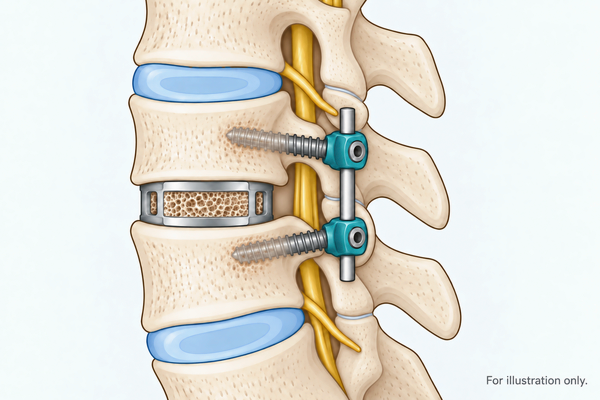
4. Spinal Fusion

Reserved for cases where the motion-preserving options listed above are not suitable. A spine fusion stops movement at the level permanently, which can transfer load onto the neighbouring segments over time, so it is not the first choice where a motion-preserving option is indicated.

Fusion in the lower back can be done from different directions: the front (anterior), the side (lateral or oblique), or the back (posterior). Each has its own advantages and suits different cases, so the right choice depends on your particular problem. It is worth asking your surgeon why they recommend a given approach, as most surgeons stick to the one or two they perform most often, which can shape their advice.

A patient's story: multi-level dynamic stabilisation with HPS 2.0

Ryan, from Medicine Hat in Canada, had lived with lower back pain for close to three decades after a hockey injury in his teens. Over the last two years it worsened sharply, culminating in a severe episode that ended in an ambulance. He first heard about the ONZ centre from three men at his gym who had each travelled to Germany for spine surgery. Within two weeks of making contact he had his evaluation back, and shortly afterwards he underwent a multi-level dynamic stabilisation with the HPS 2.0 system, across three levels from L2 to L5, with facet joint deterioration at L4/L5 part of the picture.

He checked in the day before surgery and was operated on by Dr. Bierstedt the next morning. By day four or five he was managing stairs, which he said he would not have believed possible so soon. Towards the end of his second week, at the Medicos Aufschalke rehabilitation centre, he was walking for around 45 minutes after a full day of therapy sessions, and largely pain-free.

By the time he recorded this, Ryan described the back pain he had arrived with as gone, with only the expected post-surgical soreness remaining, and, having had the height between his vertebrae restored, he said he is “a little bit taller now.”

What we see at Spine Connection

Dr. Thomas Bierstedt is a neurosurgeon and spine surgeon at ONZ International in Germany, and a member of EuroSpine and AO Spine. He has spent much of his career on motion-preserving alternatives to spinal fusion, in both the lumbar and cervical spine, and has been closely involved in the clinical development and study of motion-preserving facet surgery from its early years, including as an international reference investigator and data coordinator for the multi-centre European trials of the TOPS facet replacement system.

Frequently Asked Questions

It means the small joints at the back of your spine show wear, the same kind of arthritis that affects other joints. Radiologists use several words for it: facet arthrosis, facet joint osteoarthritis, facet hypertrophy and facet degeneration all describe the same thing. Seeing it on a report is common with age and does not on its own mean the joints are causing your pain.

Mild means the cartilage has started to thin. Moderate means the joint space has narrowed and small bone spurs have formed. Severe means the joint is markedly worn and enlarged. Grading describes the picture, not the pain. Someone with mild wear can have significant symptoms and someone with severe wear can have none, so the grade should never decide your treatment on its own.

Bilateral means both facet joints at that spinal level are affected, rather than just one side. Facet joints come in pairs (right and left), so bilateral wear is common and expected with age. It describes where the wear is, not how serious it is.

It means more than one level of the spine shows facet joint wear, for example L3/L4 and L4/L5 together. Like bilateral, it describes distribution rather than severity, and it is a normal finding on the scans of many people over 50 who have no back pain at all.

For most people, no. It is one of the more common causes of chronic low back pain and the large majority are managed without surgery, with activity, physiotherapy and anti-inflammatory medication. It becomes more significant when it contributes to nerve compression, spinal stenosis, or instability. Those are the cases worth having assessed by a spine specialist.

No, but they usually travel together. Degenerative disc disease affects the cushioning disc at the front of the spinal level and facet arthropathy affects the paired joints at the back. As a disc loses height, more load transfers onto the facet joints behind it, so facet wear is frequently a consequence of disc wear. Which one is driving your pain changes what treatment is appropriate.

Treatment works up a ladder. Most people need only conservative care: staying active, targeted physiotherapy and anti-inflammatory medication. Where a diagnostic block confirms the facet joints as the source, radiofrequency ablation can give months of relief in carefully selected patients. Surgery is considered only where there is a clear structural cause such as nerve compression, instability, or associated stenosis. The latest surgical solutions for Facet Arthropathy include TOPS Facet Joint Replacement, and HPS 2.0 Dynamic Stabilization.

Yes. Staying active within comfortable limits is the foundation of treatment, and walking is one of the better options because it keeps the joints moving without loading them heavily. What tends to aggravate facet pain is leaning backwards, twisting, and standing still for long periods, so those are worth pacing rather than avoiding entirely.

Been told you need a spinal fusion?

If you have been offered a fusion for facet arthropathy, or you are stuck on a waiting list, or facing a cost you cannot meet at home, it is worth seeking a second opinion before committing to a procedure that permanently removes movement. Our specialists in Germany and Thailand can review your imaging and tell you honestly whether disc replacement or another option fits your case, or whether a fusion is the better choice for you.

Sources

  1. Lumbar Facet Arthropathy. StatPearls (updated 2023). (https://www.ncbi.nlm.nih.gov/books/NBK538228/)
  2. Facet Joint Disease. StatPearls (updated 2025). (https://www.ncbi.nlm.nih.gov/books/NBK541049/)
  3. Lumbar Facet Joint Disease: What, Why, and When? Life, 2024. (https://doi.org/10.3390/life14111480)
  4. Cohen SP, et al. Lumbar medial branch radiofrequency ablation in patients selected by dual comparative medial branch blocks. 2019. (https://pubmed.ncbi.nlm.nih.gov/31609391/)
  5. Effectiveness of Radiofrequency Ablation for Chronic Low Back Pain: a systematic review. J Pain Res, 2026. (https://www.dovepress.com/effectiveness-of-radiofrequency-ablation-for-chronic-low-back-pain-a-s-peer-reviewed-fulltext-article-JPR)
  6. Lumbar dynamic pedicle-based stabilization versus fusion in degenerative disease: a multicentre, double-blind, randomized controlled trial. J Neurosurg Spine, 2022. (https://thejns.org/spine/view/journals/j-neurosurg-spine/37/4/article-p515.xml)
We're here
to help.
Leave your details and we will contact you to answer your questions.

Get a Spine Specialist's Opinion for Your Facet Arthropathy

Leave your details and we will contact you to answer your questions. We're here to help.


Join Our Youtube Channel

Watch videos showcasing the latest technologies and surgery techniques, and keep up to date with patient stories from around the globe.