Cover Top Placeholder

Hyperlordosis

Cover Middle Accent
Cover Bottom Height Engine
Last updated:

What is hyperlordosis?

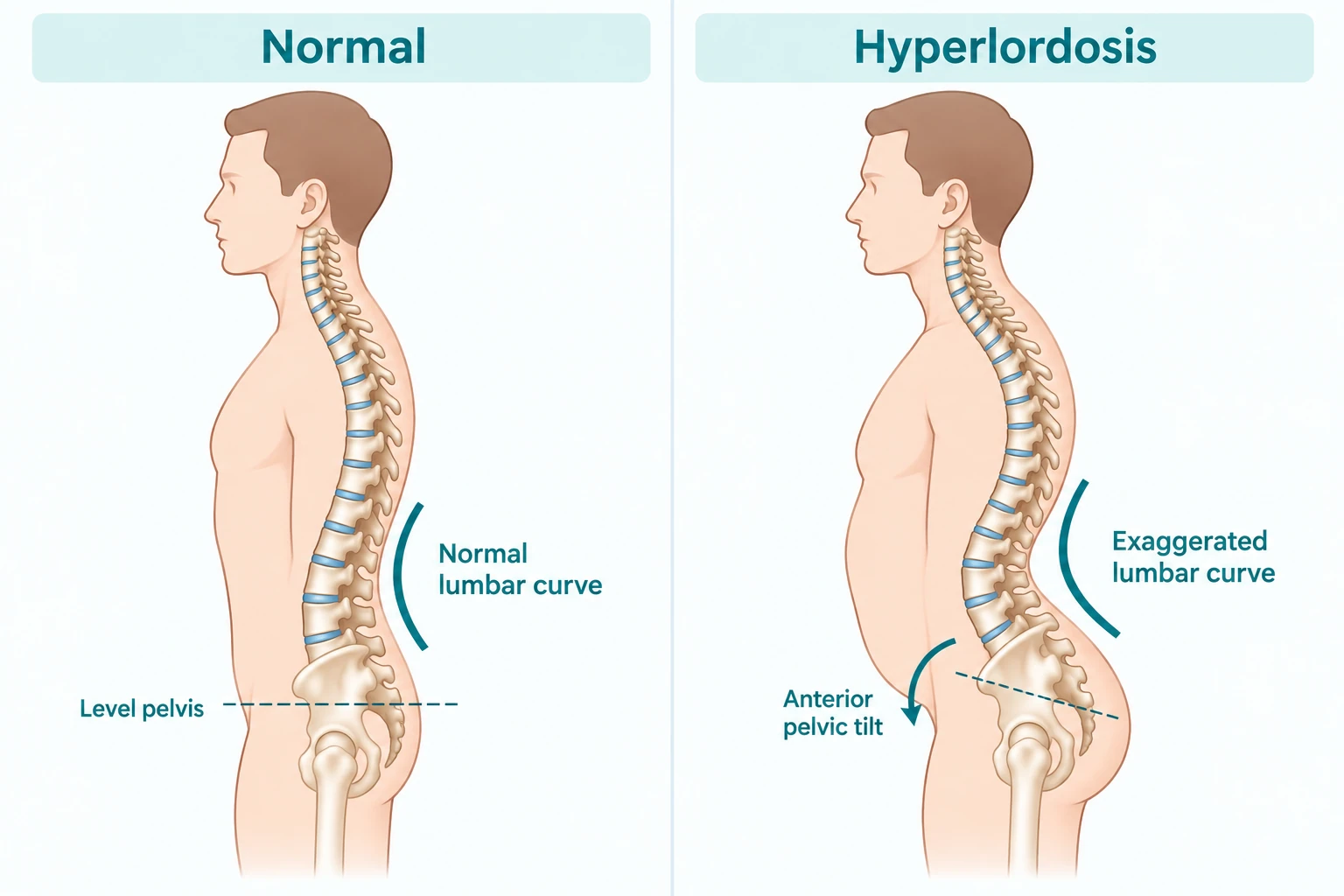
Hyperlordosis is an excessive inward curve of the lower back that tips the pelvis forward and produces the arched, hollow-backed posture often called swayback. It is also what people are describing when they ask why their back curves inward, why their lower back dips in, or why their spine looks sunken or indented. Seen from the side, a healthy spine curves inward at the neck and the lower back, a shape called lordosis, and outward in the middle back, a shape called kyphosis. An inward curve in the lower back is normal and necessary, however hyperlordosis occurs when that curve becomes too deep. The two words are often confused: lordosis is the healthy curve everyone has, while hyperlordosis is an exaggerated version of it.

Hyperlordosis can have different underlying causes. Sometimes it is simply posture and muscle balance, and sometimes the lower back is curving more to compensate for a problem elsewhere, such as a slipped vertebrae. What matters is why the curve is there, and whether it is flexible or fixed.
What does hyperlordosis feel like?

The most obvious sign is the posture itself: an exaggerated arch in the lower back, the buttocks held prominently, and the abdomen pushed forward. Lying flat on a firm surface, there is often a noticeable gap under the lower back. When hyperlordosis causes symptoms, the common one is lower back pain, particularly after standing for a while, because a deep curve concentrates load on the small joints at the back of the spine.

Pain that spreads into the leg, or numbness, tingling, or weakness, means a nerve is involved and should be medically assessed. Rapidly worsening weakness, or any loss of bladder or bowel control, needs urgent care.

Postural or structural hyperlordosis?

As with other curves of the spine, the first question is whether the curve is flexible or fixed.

Postural (flexible) hyperlordosis: the curve corrects when you change position, for example flattening when you lie down or draw your knees up. It comes from muscle balance and habit, not a change in the bones, and it responds to exercise and posture work. This is by far the most common kind.

Structural (fixed) hyperlordosis: the curve does not correct with position or effort, because it is built into the spine, either from a change in the vertebrae or because the spine is holding the curve to balance a problem elsewhere. This is the kind worth investigating, because the right treatment depends on the cause.

What causes hyperlordosis?

The causes fall into two groups.

Muscle balance and posture: tight muscles at the front of the hips, together with weak abdominal and buttock muscles, tilt the pelvis forward and deepen the lower-back curve. This is the most common cause, and it is flexible and treatable with exercise.

Load on the front of the body: extra weight carried around the abdomen, or the changes of pregnancy, shifts the body’s centre forward and increases the curve. Pregnancy-related hyperlordosis usually settles after the birth, while any pain that persists well beyond that, or that spreads into the leg, is worth having assessed rather than assumed to be a leftover of pregnancy.

Spondylolisthesis: a vertebra that has slipped forward can deepen the lower-back curve, and it is one of the structural causes we assess for.

Compensation for imbalance elsewhere: the lower back can deepen its curve to keep the body upright when there is a problem higher up the spine, or a stiff hip that tilts the pelvis. Here the curve is doing a job, and treating it in isolation can make things worse.

How is hyperlordosis measured?

Unlike a sideways curve, there is no single angle that defines hyperlordosis. The lower-back curve is measured on a standing side-on X-ray, but the normal range is wide, roughly 20 to 50 degrees, and it varies with each person’s pelvic shape. The number on its own means little.

Two things matter more. The first is whether the curve is postural or structural. The second is whether it is balanced with the pelvis and the rest of the spine. A deep curve that keeps the body balanced over the pelvis may be doing exactly what it should, whereas a curve that is fixed, or that leaves the spine out of balance, is the one that needs attention. That is a judgement about the spine’s overall balance.

How is hyperlordosis treated?

Treatment depends on whether the curve is postural or structural, and on its cause.

Postural and flexible curves: these are managed without surgery, with physiotherapy: stretching the tight muscles at the front of the hips, strengthening the abdominal and buttock muscles, posture training, and, where weight is a factor, addressing it. This is the large majority of cases.

Structural curves: where the curve is fixed or part of a larger balance problem, treatment targets the cause. Where a slipped vertebra is driving it, the slip is treated; where the curve is compensating for imbalance elsewhere, the primary problem is addressed. Conservative care comes first, and surgery is considered only where a structural cause genuinely needs it.

What are the surgery options for hyperlordosis?

Hyperlordosis is rarely operated on. When surgery has a role, it corrects the structural cause behind the curve, not the curve itself.

Where a spondylolisthesis is driving the curve, the slipped vertebra is stabilised and the nerves decompressed, and the spine is realigned to a balanced shape in the process.

Where the curve is part of a fixed imbalance, realignment surgery restores the spine’s balance over the pelvis. These operations are planned around each person’s own spinal and pelvic measurements rather than a target angle, and, where possible, done through minimally invasive, muscle-sparing approaches.

Most hyperlordosis never needs surgery, and when it does, the goal is a spine that is well balanced over the pelvis.

What we see at Spine Connection

Most hyperlordosis we are asked about is postural, and can be treated by seeing a physiotherapist. The cases we treat are the structural ones, and we start with a single question: is the deep curve the problem, or the spine’s way of compensating for one? Getting that right is important, because operating on a curve that was holding the body in balance can do more harm than good.

Dr. Chaidej Sasomboon is an orthopedic spine surgeon and Deputy Medical Director at Bangkok International Hospital. He completed fellowships in the United States, in minimally invasive spine surgery at UCSF and in complex and deformity spine surgery at Columbia University in New York, and his published clinical work is on the balance between the spine and the pelvis after lumbar surgery. He plans each case around the individual’s own spinal and pelvic alignment.

Frequently Asked Questions

Some inward curve in the lower back is normal and necessary. This is called lordosis and everyone has it. It becomes hyperlordosis when the curve is deeper than it should be, tipping the pelvis forward and producing an arched, hollow-backed posture. Most of the time this comes from muscle balance and habit rather than a change in the bones, and it improves with exercise.

Lordosis is the healthy inward curve of the lower back and neck. Hyperlordosis is an excessive version of that curve. The normal range is wide (roughly 20 to 50 degrees) and varies with each person’s pelvic shape, so a single number on a report means little on its own. What matters is whether the curve is flexible or fixed, and whether the spine stays balanced over the pelvis.

Usually not. Most hyperlordosis is postural, causes no symptoms, and responds to physiotherapy. It matters when it is fixed rather than flexible, when it causes persistent lower back pain, or when the deep curve is the spine compensating for a problem elsewhere. That last case is important, because treating the curve in isolation when it is holding the body in balance can make things worse.

Postural hyperlordosis usually improves with physiotherapy: stretching the tight muscles at the front of the hips, strengthening the abdominal and buttock muscles, and posture training. Structural hyperlordosis does not correct with exercise, because the curve is built into the spine. There, treatment targets the underlying cause – most often a slipped vertebra or a wider balance problem.

The most common cause is muscle balance: tight hip flexors combined with weak abdominal and buttock muscles tilt the pelvis forward and deepen the curve. Extra weight carried around the abdomen and the changes of pregnancy do the same thing. Structural causes include a vertebra that has slipped forward, and compensation for a problem higher up the spine or a stiff hip.

The clearest sign is the posture itself: an exaggerated arch in the lower back, the buttocks held prominently, and the abdomen pushed forward. Lying flat on a firm surface, there is often a noticeable gap under the lower back. A standing side-on X-ray measures the curve, but because the normal range is so wide, the more useful question is whether the curve corrects when you change position.

Usually, yes. Pregnancy shifts the body’s centre of gravity forward, which deepens the lower back curve, and this typically settles after the birth. Pain that persists well beyond that, or that spreads into the leg, is worth having assessed rather than assumed to be a leftover of pregnancy.

Been told your posture or curve is a problem?

If your swayback posture comes with back pain, has not improved with exercise, or has been linked to a slipped vertebra or a balance problem in the spine, it is worth a proper assessment. Our specialists in Thailand and Germany can review your imaging, work out whether the curve is postural or structural and whether it is balanced, and tell you honestly whether it needs treatment at all, and if so, what kind.

Sources

  1. Spine Sagittal Balance. StatPearls (updated 2023). (The spine balances cervical lordosis, thoracic kyphosis, lumbar lordosis, and the pelvis; normal lumbar lordosis is a wide range of about 20 to 50 degrees; hyperlordosis can be a compensation for imbalance.) (https://www.ncbi.nlm.nih.gov/books/NBK534858/)
  2. Spondylolisthesis. StatPearls (updated 2023). (A forward slip of a vertebra, which can increase the lower-back curve.) (https://www.ncbi.nlm.nih.gov/books/NBK430767/)
  3. Hip-Spine Syndrome: anterior pelvic tilt and lumbar hyperlordosis. Journal of Bone and Joint Surgery, 2019. (A flexion deformity of the hip rotates the pelvis forward and exaggerates the normal lumbar lordosis.) (https://pmc.ncbi.nlm.nih.gov/articles/PMC6510466/)
  4. Adult Spinal Deformity: A Comprehensive Review of Current Advances. Asian Spine Journal, 2022. (Sagittal balance, not the curve alone, guides the assessment and treatment of spinal deformity.) (https://www.asianspinejournal.org/journal/view.php?doi=10.31616/asj.2022.0376)
We're here
to help.
Leave your details and we will contact you to answer your questions.

Get a Spine Specialist's Opinion for Your Hyperlordosis

Leave your details and we will contact you to answer your questions. We're here to help.


    Join Our Youtube Channel

    Watch videos showcasing the latest technologies and surgery techniques, and keep up to date with patient stories from around the globe.