Thank You!

Your message has been submitted successfully. We will get back to you shortly.

Cover Top Placeholder

Sacroiliac (SI) Joint Dysfunction

Cover Middle Accent
Cover Bottom Height Engine
Last updated:

What is SI joint dysfunction?

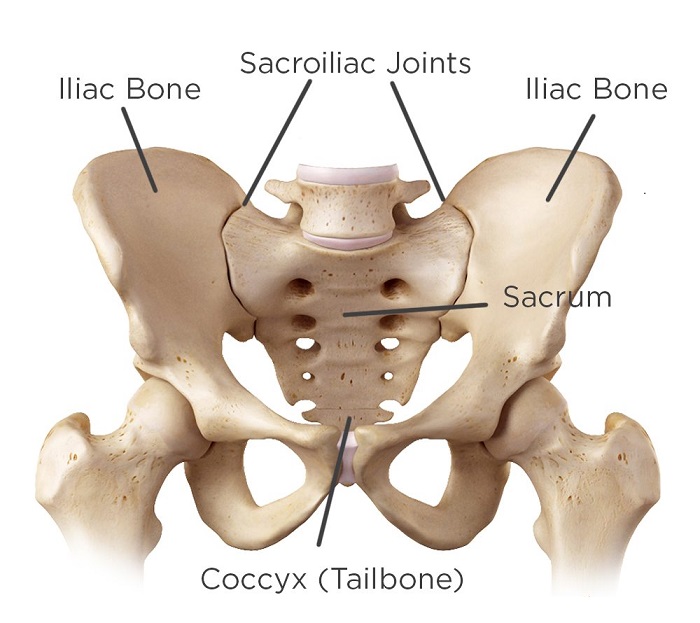
The sacroiliac (SI) joints are the two joints that connect the base of the spine (the sacrum) to the pelvis, one on each side, just above the buttocks. They are strong, held together by thick ligaments, and move very little. Their job is to transfer the load of the upper body into the legs and to absorb shock. SI joint dysfunction is pain that comes from one of these joints when it moves too much, too little, or becomes inflamed.

It is often overlooked, because its symptoms overlap with more familiar causes of low back pain. Studies estimate the SI joint is the source of pain in roughly 15 to 30% of people with chronic low back pain, which makes it far more common than many people, and some clinicians, assume.
Patient Education Video

What does SI joint dysfunction feel like?

The most telling sign is pain on one side, low over the buttock or the back of the pelvis, that many people can pin down to a single spot with a fingertip just beside the base of the spine. It tends to flare with movements that load one side of the pelvis: getting up from a chair, rolling over in bed, getting out of the car, going up stairs, or standing on one leg. It can spread into the buttock, groin, or the back of the thigh, but usually stays above the knee. It is more common in younger and middle-aged women, partly because of the effect of pregnancy on the pelvic ligaments.

As with any back or pelvic pain, some symptoms need urgent attention rather than watchful waiting: loss of bladder or bowel control, numbness around the groin or inner thighs, or leg weakness that is quickly getting worse.

What causes SI joint dysfunction?

The problem usually comes down to the joint moving abnormally, either too much or too little, and there are several common triggers:

  • Pregnancy and childbirth: hormones loosen the pelvic ligaments and the changing load can leave the joint irritated or unstable, which is part of why it is more common in women.
  • Injury: a fall onto the buttock, a car accident, or a heavy landing can strain or disrupt the joint.
  • Uneven loading: a difference in leg length, a change in the way you walk, or hip and knee problems can load one side unevenly over time.
  • Previous lumbar fusion: fusing the lower spine transfers extra stress onto the SI joints, and they can become a source of pain afterwards.
  • Arthritis and inflammation: wear of the joint, or inflammatory conditions such as ankylosing spondylitis, can involve the SI joints.

How is SI joint dysfunction diagnosed?

SI joint dysfunction is one of the harder causes of low back pain to work out, because it looks so much like a disc problem, facet joint pain, or sciatica. Diagnosis usually combines three things: the pattern of your symptoms, a set of physical provocation tests that stress the joint in different ways (the picture is more convincing when several of them are positive), and, most reliably, a diagnostic injection.

Placing local anaesthetic into the joint under image guidance, and seeing the pain drop substantially, is the most dependable way to confirm that the SI joint is the source. That confirmation is important because it is what separates the people who will benefit from targeted treatment, from those whose pain is coming from somewhere else. Scans (X-ray, CT, or MRI) are used mainly to rule other causes in or out.

What forms does SI joint dysfunction take?

SI joint dysfunction is not graded in stages the way some spine conditions are. What matters more is the kind of problem the joint has:

Too much movement (hypermobility): the joint moves more than it should, often after pregnancy or an injury that has loosened the supporting ligaments. This is the most common pattern in younger and middle-aged women.

Too little movement (hypomobility): the joint becomes stiff or locked, which can be just as painful as a joint that moves too much.

Inflammation: in some people the joint is inflamed as part of an inflammatory condition such as ankylosing spondylitis, rather than from a mechanical problem.

Working out which of these is behind the pain matters, because it shapes both the exercises that help and whether an inflammatory cause needs treating in its own right.

How is SI joint dysfunction treated?

Most SI joint dysfunction is managed without surgery.

  1. Conservative care (first line): activity modification, physiotherapy aimed at stabilising the pelvis and core, and a pelvic support belt for some people, alongside pain relief where appropriate. Where pregnancy is the trigger, symptoms often settle in the months after the birth.
  2. Injections: a steroid injection into the joint, done under image guidance, can both help confirm the diagnosis and give a period of relief.
  3. Radiofrequency ablation: if an injection helps only briefly, using heat to interrupt the small nerves that carry pain from the joint can give some people longer-lasting relief.
  4. Surgery: where the diagnosis is confirmed and good conservative care has not settled the pain, minimally invasive fusion of the joint is the definitive option.

What does SI joint fusion involve?

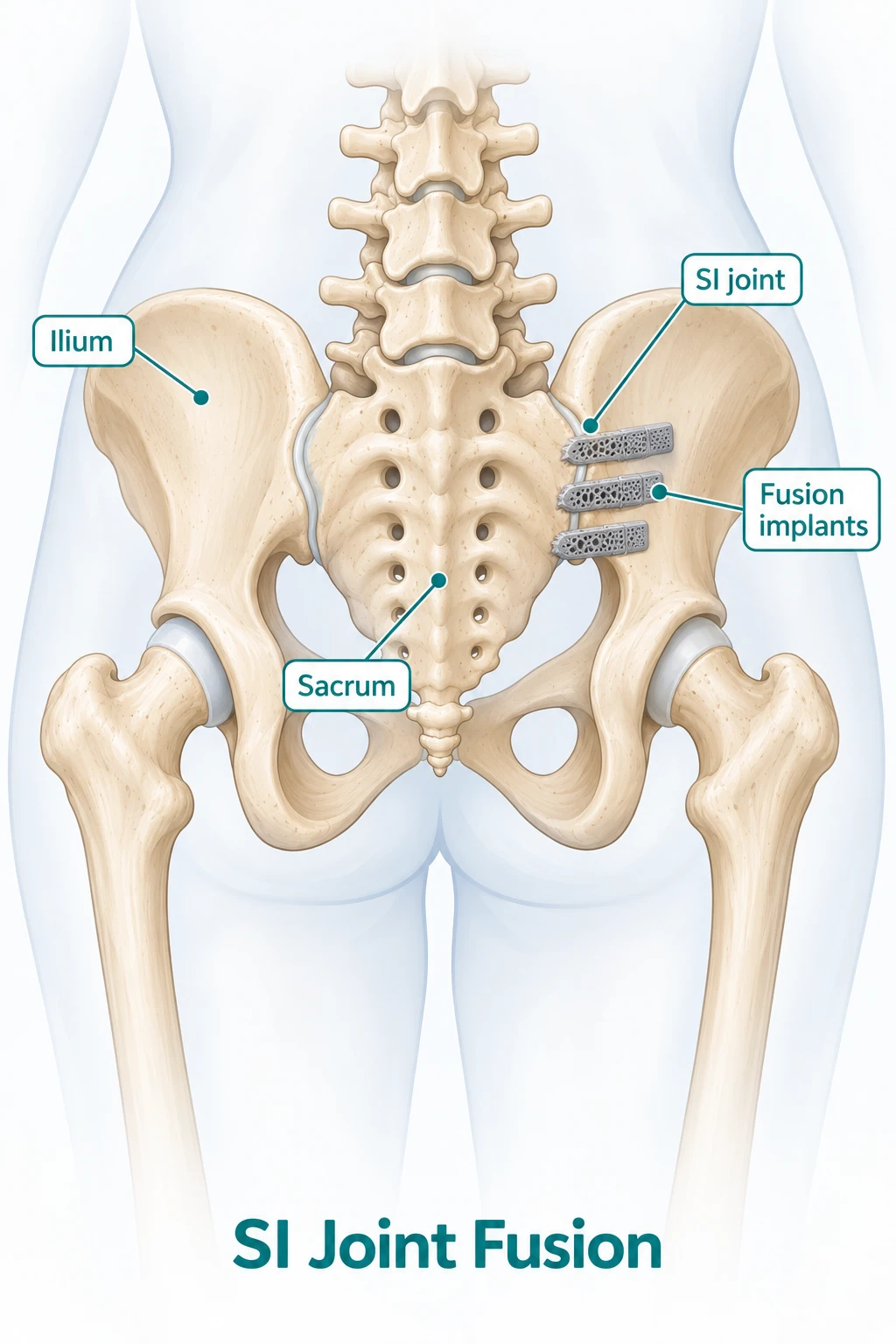
For a confirmed, persistent case, the SI joint can be stabilised and fused so that the painful abnormal movement stops. It is done in a minimally invasive way: through one or two small incisions, using image guidance, the surgeon places implants across the joint to lock it and allow it to fuse, without the large muscle disruption of older open operations.

This is a different proposition from fusion in the mobile spine. There, preserving movement is usually the priority, which is why our other pages lean towards motion-preserving options. The SI joint, by contrast, moves very little to begin with, so fusing it does not cost any meaningful motion, and it is a well-studied treatment. For confirmed cases that have not responded to conservative care, randomized trials have found minimally invasive SI joint fusion more effective than continued non-surgical treatment.

The key point here is patient selection. Because SI joint pain is easy to over-diagnose, the diagnosis has to be confirmed first, with provocation tests and a diagnostic block, so that the operation is done on the joint that is genuinely the source. When done for the right patient, it is one of the more reliable operations in spine care.

What we see at Spine Connection

SI joint dysfunction is both under-diagnosed and, once correctly identified, very treatable, so getting the diagnosis right is where we start. When surgery is the answer, it is worth having it done by a surgeon who performs it regularly, and we can arrange this at either of our centres.

In Germany: Dr. Thomas Bierstedt is a neurosurgeon and spine surgeon at ONZ International, and a member of EuroSpine and AO Spine. For SI joint fusion he uses the SI-Bone iFuse system, chosen for its triangular titanium design, which resists rotation, encourages bone to grow into the implant, and gives long-term stability through a small keyhole incision. It is the same implant design used in the randomized trials of the procedure.

In Thailand: Dr. Tayard Buranakarl is a senior spine surgeon at the Bangkok Spine Academy and Bangkok International Hospital, and a Key Opinion Leader for Medtronic. He was the first surgeon in Thailand to perform minimally invasive SI joint fusion, and he now teaches the technique, running clinical workshops for visiting surgeons from across the Asia-Pacific region and beyond. For a procedure where accurate placement counts for a great deal, being treated by a surgeon who trains others in it is about as reassuring as it gets.

Frequently Asked Questions

The sacroiliac joints sit where the base of the spine meets the pelvis, one on each side, roughly beneath the dimples at the top of the buttocks. Pain from them is usually felt low and to one side, in the buttock, and can spread into the groin or down the back of the thigh. It typically stops above the knee, which helps distinguish it from sciatica.

Several things. Pregnancy and childbirth loosen the ligaments that hold the joint. A fall onto the buttock or a heavy landing can injure it. Arthritis affects it like any other joint. Uneven loading from a leg length difference, a hip problem, or a spinal curve can strain it over time. It is also a recognised consequence of lumbar fusion, because the level below a fused segment takes extra load.

The usual pattern is pain low on one side of the back or in the buttock, often worse with standing up from sitting, climbing stairs, standing on one leg, or rolling over in bed. Sitting for long periods can aggravate it. Some people describe a sense of the joint giving way or catching. Pain that travels below the knee points more towards a nerve than the joint.

There is no single scan that confirms it. Diagnosis rests on the pattern of symptoms, a set of physical examination tests that stress the joint, and most reliably a diagnostic injection of local anaesthetic into the joint. If that removes a high proportion of the pain, it points to the joint as the source. Imaging is used mainly to rule out other causes.

Some of it, yes. Gentle mobility work, targeted strengthening of the muscles around the pelvis, and pacing the activities that aggravate it help many people, and a physiotherapist can teach the right exercises. Forceful self-manipulation to “unlock” the joint is not advisable, particularly where the joint is already too mobile rather than too stiff. Getting the diagnosis right first matters, because the exercises differ.

No, though they can feel similar. Sciatica comes from a compressed nerve root in the lower spine and typically travels down the leg past the knee, often with pins and needles or numbness. SI joint pain comes from the joint itself and usually stays in the buttock and upper thigh. The SI joint can mimic sciatica closely enough that a diagnostic injection is sometimes the only way to be sure.

Most SI joint pain is managed without surgery: physiotherapy focused on the muscles that stabilise the pelvis, activity modification, pain relief, and where needed a steroid injection into the joint. Where the pain is confirmed by injection and has not settled, radiofrequency ablation of the nerves supplying the joint can help. Fusion of the joint is reserved for a small minority with confirmed, persistent pain.

Been told your back pain is something else?

If your low back or buttock pain has been put down to a disc or to sciatica but has never quite fitted, or you have a confirmed SI joint problem that conservative care has not settled, it is worth a second opinion. Our specialists in Thailand and Germany can review your case, help confirm whether the SI joint really is the source, and tell you honestly whether conservative care, an injection, or minimally invasive fusion is the right next step for you.

Sources

  1. Szadek K, et al. Sacroiliac joint pain. Pain Practice, 2024. (The sacroiliac joint accounts for an estimated 15 to 30% of mechanical low back pain; diagnosis rests on provocation tests and a diagnostic block.) (https://pubmed.ncbi.nlm.nih.gov/38155419/)
  2. Buchanan P, et al. Successful Diagnosis of Sacroiliac Joint Dysfunction. Journal of Pain Research, 2021. (A common but frequently under-diagnosed source of low back pain; approach to confirming the diagnosis.) (https://www.ncbi.nlm.nih.gov/pmc/articles/PMC8517984/)
  3. Minimally invasive sacroiliac joint fusion using triangular titanium implants versus nonsurgical management for sacroiliac joint dysfunction: a systematic review and meta-analysis. Canadian Journal of Surgery, 2024. (https://www.canjsurg.ca/content/67/1/E16)
  4. Polly DW, et al.; INSITE Study Group. Two-year outcomes from a randomized controlled trial of minimally invasive sacroiliac joint fusion vs. non-surgical management for sacroiliac joint dysfunction. International Journal of Spine Surgery, 2016. (Larger, durable improvements in pain, disability, and quality of life versus non-surgical management.) (https://www.ijssurgery.com/content/10/28)
We're here
to help.
Leave your details and we will contact you to answer your questions.

Get a Spine Specialist's Opinion for Your Sacroiliac (SI) Joint Dysfunction

Leave your details and we will contact you to answer your questions. We're here to help.


    Join Our Youtube Channel

    Watch videos showcasing the latest technologies and surgery techniques, and keep up to date with patient stories from around the globe.