Thank You!

Your message has been submitted successfully. We will get back to you shortly.

Cover Top Placeholder

Spinal Fractures

Cover Middle Accent
Cover Bottom Height Engine
Last updated:

What is a spinal fracture?

A spinal fracture is a break in one of the vertebrae, the bones that stack up to form the spine. Most people searching for this call it a broken back, and a fractured vertebra, a fractured spine and a broken back all describe the same injury. The bone does not have to break in two: most often the front of a vertebra crumples and loses height, which is called a compression fracture. What matters most with any spinal fracture is why it happened and whether it is stable, because that is what decides how it is treated.

Most spinal fractures fall into two groups. The larger group are fragility fractures, where a vertebra weakened by osteoporosis gives way under everyday load, sometimes with something as minor as a cough, a lift, or a small stumble. These are common: studies estimate around 1.5 million occur each year in the United States, making them almost twice as common as the better-known osteoporotic hip and wrist fractures, and a first one is often the earliest sign that the bones have become fragile. The other group are traumatic fractures, from a high-energy impact such as a car accident, a fall from a height, or a heavy sporting injury.

Patient Education Video

What does a spinal fracture feel like?

The usual symptom is back pain that comes on suddenly, is worse with moving, standing, or lifting, and eases when lying down. With an osteoporotic fracture the pain may follow a minor strain, or appear with no clear trigger at all. Many people keep walking with a spinal fracture, which is one reason they get missed: most are stable compression fractures, and the pain is easily mistaken for an ordinary bad back. Some cause so little pain that they are found later on a scan taken for another reason. Over time, several compression fractures can add up to lost height and a stooped, rounded upper back.

Some symptoms are a medical emergency and need immediate care rather than watchful waiting: numbness, tingling, or weakness in the arms or legs, difficulty walking, or any loss of bladder or bowel control. These can mean the fracture is pressing on the spinal cord or nerves.

What causes spinal fractures?

There are three main routes to a spinal fracture:

  • Osteoporosis and fragile bone: as bone loses density with age, and particularly after menopause, a vertebra can fracture under ordinary load. This is the most common cause, and it is why treating the underlying bone weakness is part of treating the fracture itself.
  • Trauma: a high-energy impact such as a car accident, a fall from a height, or a heavy landing in sport can break an otherwise healthy vertebra.
  • Tumour or infection: less often, a growth or an infection can weaken a vertebra until it breaks, which is one reason imaging is important in making the diagnosis.

What are the different types?

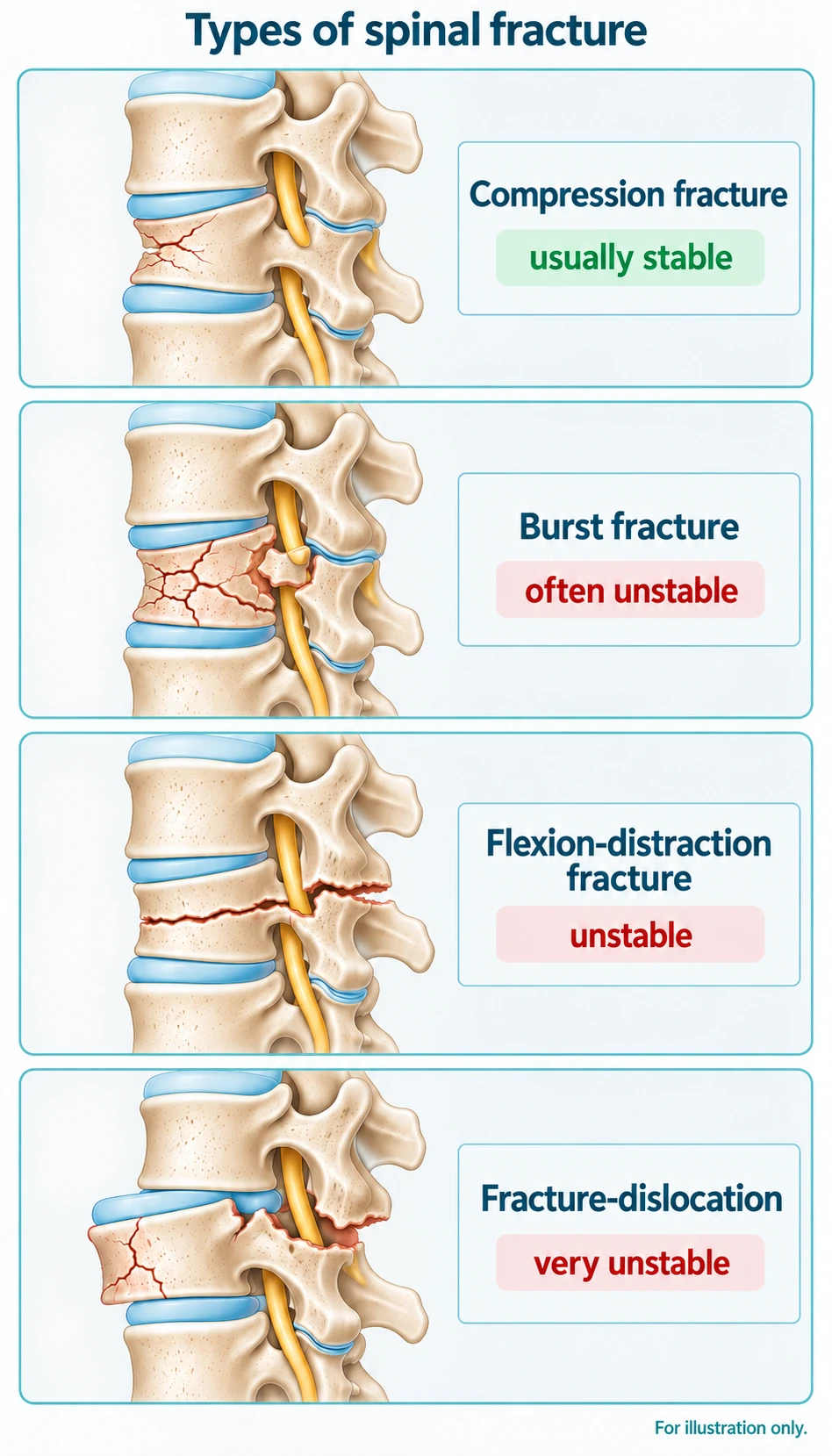
Spinal fractures are grouped by their pattern, but the practical question with any of them is whether the fracture is stable or unstable:

  • Compression fracture: the front of the vertebra crumples into a wedge shape. This is the typical osteoporotic fracture and is usually stable.
  • Burst fracture: the vertebra shatters in several directions, usually from high-energy trauma, and fragments of bone can be pushed towards the spinal cord. These are often unstable.
  • Flexion-distraction fracture: the vertebra is pulled apart by a sudden forward-bending force, such as in a seatbelt injury during a crash.
  • Fracture-dislocation: the vertebra shifts out of line with the ones around it, which is a very unstable injury.

A stable fracture holds the spine’s alignment and rarely threatens the nerves. An unstable one can shift and put the spinal cord at risk, and that distinction is usually what decides whether surgery is needed.

How are spinal fractures diagnosed?

An X-ray shows the fracture and any loss of height in the vertebra. A CT scan gives the fine detail of the bone, which matters most for burst fractures, and an MRI can tell a recent, still-painful fracture from an old healed one, show whether the cord or nerves are being compressed, and help rule out a tumour or infection. Where osteoporosis is the likely cause, a bone-density (DEXA) scan measures how fragile the bone is, which guides treatment of the underlying problem.

How are spinal fractures treated?

Most stable fractures, including the majority of osteoporotic compression fractures, heal without surgery.

1. Conservative care, and treating the bone: pain relief, a short easing of activity followed by a gentle return to movement (prolonged bed rest is no longer advised), and a brace for some fractures. Just as important, where the cause is osteoporosis, treating the underlying bone weakness with medication is what most reduces the risk of the next fracture, and guidelines treat this as an essential part of care rather than an afterthought.

2. Cement augmentation (vertebroplasty and kyphoplasty): a minimally invasive procedure that injects bone cement into the fractured vertebra to stabilise it and ease pain; kyphoplasty first uses a small balloon to restore some of the lost height. The evidence here is mixed: some placebo-controlled trials found little benefit, while others suggest it helps most when a recent, painful fracture is treated early and has not settled with other measures, so it is a considered choice rather than a routine one.

3. Surgical stabilisation: for an unstable fracture, a burst fracture pressing on the nerves, or a fracture that will not heal, the spine is stabilised with screws and rods and any pressure on the nerves is relieved, often through small, minimally invasive incisions rather than a large open operation. Osteoporotic bone adds a challenge, because weak bone can struggle to hold ordinary fixation, so techniques designed for fragile bone are used where needed. Our Thailand specialist Dr. Tayard introduced the MIS-CAPT technique for exactly this, a minimally invasive way to secure the spine safely in fragile or osteoporotic bone.

What we see at Spine Connection

A spinal fracture, especially a first one from only minor force, is often the moment osteoporosis is finally recognised, so we treat two things at once: the fracture, and the bone weakness behind it, so that the next fracture is less likely. Most of the fractures we see are stable and heal well. The ones that need surgery are the unstable or non-healing fractures, and in fragile bone the priority is fixation that will actually hold. Multiple compression fractures can also round the upper back over time.

Dr. Tayard Buranakarl is a senior spine surgeon at the Bangkok Spine Academy and Bangkok International Hospital, and a Key Opinion Leader for Medtronic. He was the first surgeon in Thailand to introduce the MIS-CAPT technique, a minimally invasive way to stabilise the spine in patients with fragile or osteoporotic bone, and he trains visiting surgeons from across the Asia-Pacific region in minimally invasive spine techniques.

Frequently Asked Questions

Yes, you can, and that is part of why spinal fractures get missed. Most spinal fractures are stable compression fractures where the front of a vertebra crumples, and many people continue walking with what they assume is bad back pain. An unstable fracture is different and can put the spinal cord at risk. Any back pain after a fall, or sudden severe back pain with no clear cause, should be assessed rather than walked off.

The usual symptom is back pain that comes on suddenly, is worse with moving, standing or lifting, and eases when lying down. With a fracture in weakened bone, the pain may follow something minor like a cough or a small stumble, or appear with no clear trigger at all. Over time, several compression fractures can add up to lost height and a stooped upper back.

Yes. Fractures in bone weakened by osteoporosis can happen under ordinary load and cause pain that is mistaken for an ordinary bad back. Some cause very little pain at all and are found later on a scan taken for another reason. A first fragility fracture is often the earliest sign that the bones have become fragile, which is why finding one should always prompt a look at bone health.

Most compression fractures are stable, do not threaten the nerves, and heal without surgery. What makes any spinal fracture serious is instability, where it can shift and put the spinal cord at risk. Numbness, tingling, weakness in the arms or legs, difficulty walking, or any loss of bladder or bowel control needs immediate care, because those suggest pressure on the cord or nerves.

Three main routes. Bone weakened by osteoporosis can fracture under everyday load, and this is the most common cause, with around 1.5 million vertebral compression fractures occur each year in the United States. High-energy trauma such as a car accident or a fall from height can break an otherwise healthy vertebra. Less often, a tumour or infection weakens a vertebra until it gives way.

Most stable fractures heal over roughly six to twelve weeks with pain relief, a gentle return to movement, and a brace in some cases. Prolonged bed rest is no longer advised and slows recovery. Where osteoporosis is the cause, treating the underlying bone weakness matters as much as the fracture itself, because that is what most reduces the risk of the next one.

Most do not. Surgery is for fractures that are unstable, that are pressing on the nerves, or that will not heal. Cement augmentation (vertebroplasty or kyphoplasty) is the name of the surgery technique, and the evidence for it is genuinely mixed, so it is a considered choice rather than a routine one. In fragile or osteoporotic bone the priority in any operation is fixation that will actually hold.

Not sure whether a spinal fracture needs surgery?

If you or a family member has had a spinal fracture and you are unsure what happens next, it is worth a second opinion. Our specialists in Germany and Thailand can review the imaging and tell you honestly whether it should heal with conservative care and treatment of the bone, whether a cement procedure is worth considering, or whether it is unstable and genuinely needs stabilising.

Sources

  1. Osteoporosis and Spinal Fractures. OrthoInfo, American Academy of Orthopaedic Surgeons. (About 1.5 million vertebral compression fractures a year in the US, almost twice as common as osteoporotic hip and wrist fractures; a fracture is often the first sign of weak bone.) (https://orthoinfo.aaos.org/en/diseases--conditions/osteoporosis-and-spinal-fractures/)
  2. Vertebral Fracture. StatPearls (updated 2023). (Etiologies including osteoporosis and trauma; most stable fractures are managed conservatively, without surgery.) (https://www.ncbi.nlm.nih.gov/books/NBK547673/)
  3. LeBoff MS, et al. The clinician's guide to prevention and treatment of osteoporosis. Osteoporosis International, 2022. (Treating the underlying osteoporosis is essential to reduce the risk of further fractures.) (https://pubmed.ncbi.nlm.nih.gov/35478046/)
  4. Treatment for Osteoporotic Vertebral Fracture: a short review of orthosis and percutaneous vertebroplasty and balloon kyphoplasty. Neurospine, 2023. (Reviews bracing and cement augmentation, including the placebo-controlled debate and the greater benefit seen when acute fractures are treated early.) (https://www.e-neurospine.org/journal/view.php?number=1488)
We're here
to help.
Leave your details and we will contact you to answer your questions.

Get a Spine Specialist's Opinion for Your Spinal Fractures

Leave your details and we will contact you to answer your questions. We're here to help.


    Join Our Youtube Channel

    Watch videos showcasing the latest technologies and surgery techniques, and keep up to date with patient stories from around the globe.