Cover Top Placeholder

Back Sprains and Strains

Cover Middle Accent
Cover Bottom Height Engine
Last updated:

What are back sprains and strains?

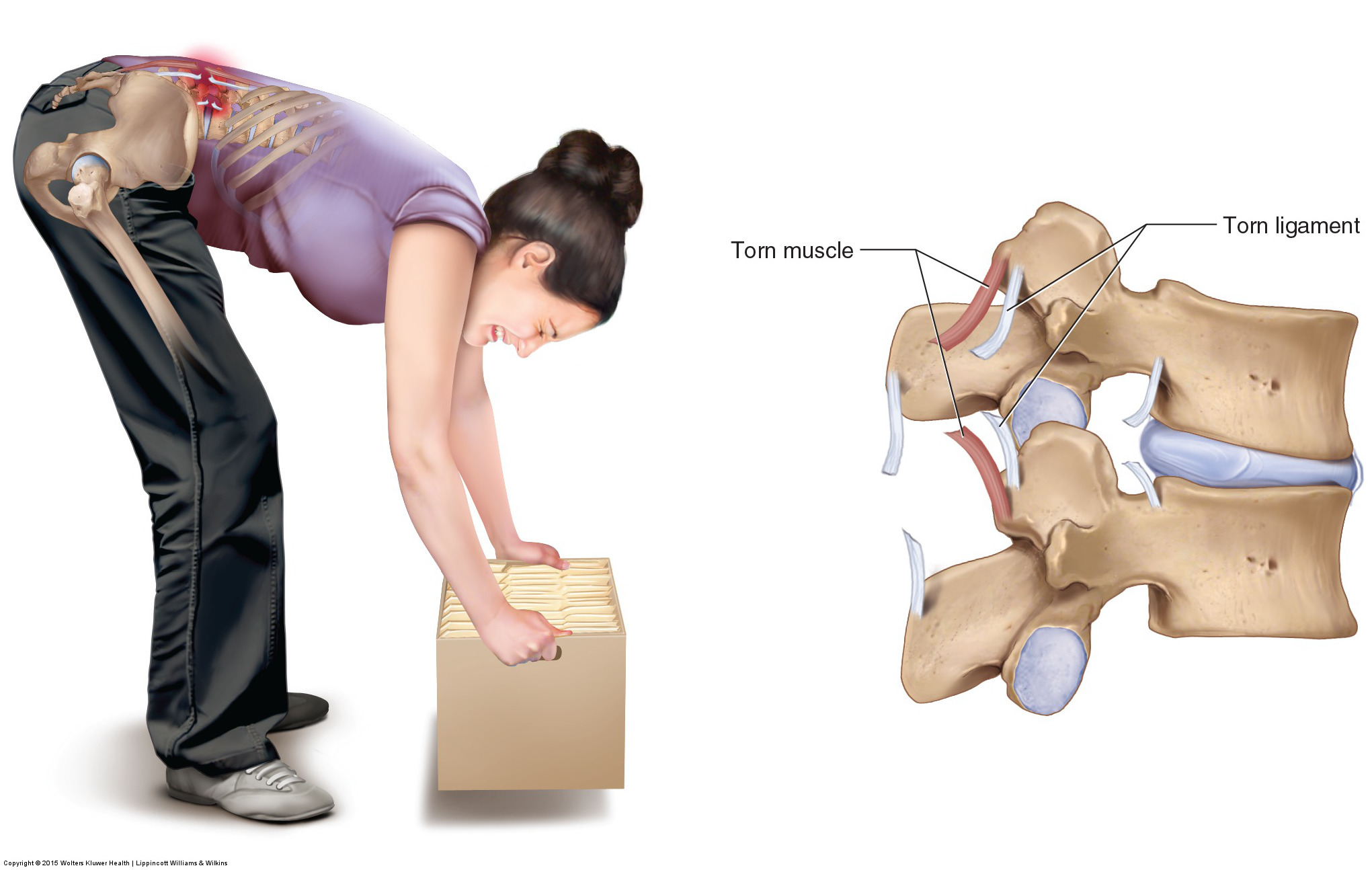
A back sprain or strain is a soft-tissue injury of the back or neck, and it is behind most sudden, short-lived back pain. A strain is an overstretched or torn muscle or tendon; a sprain is an overstretched or torn ligament, the bands that hold the vertebrae together. The two often happen together and feel much the same, which is why they are usually grouped as one, and the distinction rarely changes how they are treated. The great majority settle on their own.

This is the most common cause of back pain, and it is also one of the least serious: around nine in ten people recover fully. It is worth knowing the few signs that a back injury is more than a simple sprain, and those are set out further down, but for most people this is a matter of sensible care and a little time.
Patient Education Video

What do they feel like?

The typical picture is pain and stiffness in the injured area, often with muscle spasm as the surrounding muscles tighten to protect it. The pain may be sharp at first and then settle to a dull ache; it is usually worse with movement, bending, or lifting, and it eases with rest. There is often local tenderness and, for a day or two, some difficulty standing fully upright.

One feature matters more than any other: a simple sprain or strain causes pain around the back or neck itself, not down the limbs. Pain that shoots into a leg or arm, or numbness, tingling, or weakness there, points away from a simple sprain and toward a nerve, which is covered below.

What causes back sprains and strains?

Most happen when the soft tissues are loaded more than they can take:

  • Lifting: lifting something too heavy, or lifting awkwardly with a bent and twisted back, is the classic cause.
  • Sudden movements: a quick twist, a fall, or a sporting impact can overstretch a muscle or ligament.
  • Overuse: repeated bending, lifting, or awkward postures over a long day can strain the tissues without a single obvious moment of injury.
  • Deconditioning: weak core and back muscles, and long periods of poor posture, leave the spine less protected and easier to injure.

How are back sprains and strains diagnosed?

A back sprain or strain is diagnosed from the story of how it happened and a physical examination, not from a scan, and most cases need no imaging at all. When imaging is used, each test has a specific role, and none of them confirms the sprain itself:

  • X-ray: shows bone, not soft tissue, so it cannot show a sprained ligament or a strained muscle. It is used only to rule out a fracture or an alignment problem after a significant injury.
  • MRI: shows the soft tissues, discs, ligaments, and nerves, but it is not used early for a simple sprain. Scanning too soon tends to turn up harmless age-related changes that muddy the picture, so an MRI is reserved for pain that has not settled or where a nerve problem is suspected.
  • Ultrasound: is not part of diagnosing spinal sprains and strains. It works well for soft-tissue injuries in the limbs, but the spinal ligaments and deep back muscles sit too deep, and behind bone, to be seen clearly.

How are back sprains and strains treated?

Nearly all back sprains and strains are treated simply, and most settle within a few weeks.

  • Keep moving: a short rest from heavy activity is fine, but prolonged bed rest slows recovery. Returning to gentle, normal movement as soon as the pain allows gives the best results.
  • Ease the pain: over-the-counter anti-inflammatories, and heat or ice, help with pain and spasm in the early days.
  • Rebuild: if the pain is slow to settle, physiotherapy to restore movement and strengthen the core and back muscles is the most useful next step, and it lowers the chance of it happening again.
  • How long it takes: a mildly overstretched muscle or ligament usually improves over two to four weeks. A more significant tear can take several months. What matters is that it is steadily improving; pain that is no better after about six weeks is worth having looked at.

Around nine in ten people recover fully. Staying active, lifting well, and keeping the back and core muscles strong are the best protection against a repeat.

When is it not a sprain?

Most back pain that starts suddenly is a sprain or strain and settles. A few patterns suggest something else is going on, and are worth having looked at properly:

  • Pain that will not settle: a sprain should be improving within a few weeks. Pain that is no better after about six weeks may be coming from a disc rather than the soft tissues.
  • Pain that spreads into a limb: pain that runs down a leg or arm, or numbness, tingling, or weakness there, suggests an irritated nerve rather than a simple sprain.
  • The same injury, again and again: a back that keeps giving way in the same spot can point to an underlying instability rather than a fresh sprain each time.

Some symptoms need urgent medical care straight away, not watchful waiting: loss of bladder or bowel control, numbness around the groin or inner thighs, severe or spreading leg weakness, or back pain with fever, unexplained weight loss, or pain that is worse at night. These are uncommon, but they matter.

What we see at Spine Connection

Most sprains and strains never need a specialist, and we would rather tell someone that than sell them a problem they do not have. The cases where we can help are the ones hiding in this group: a sprain that never settles and turns out to be a worn or herniated disc. Where that is the cause, it is very treatable, and it does not always mean fusion.

Our German centre, including neurosurgeon Dr. Bernd Illerhaus, focuses on motion-preserving disc replacement for exactly these cases, treating the disc that is actually causing the pain while keeping the segment moving.

Frequently Asked Questions

A strain is an overstretched or torn muscle or tendon. A sprain is an overstretched or torn ligament – the bands that hold the vertebrae together. In practice the two often happen together and feel much the same, which is why they are usually grouped. The distinction rarely changes the treatment: both are managed with early movement, pain relief, and rehabilitation.

Yes, and it is the single most common cause of sudden back pain. Lifting something too heavy, lifting awkwardly with a bent and twisted back, a quick twist, or a fall can all overstretch the ligaments and muscles supporting the spine. It is also one of the least serious causes: around nine in ten people recover fully.

Pain and stiffness in the injured area, often with muscle spasm as the surrounding muscles tighten to protect it. The pain may be sharp at first and then settle to a dull ache, is usually worse with movement, bending or lifting, and eases with rest. There is often local tenderness and, for a day or two, difficulty standing fully upright.

Most settle within a few weeks. A mildly overstretched ligament or muscle typically improves over two to four weeks; a more significant tear can take several months. The key is direction of travel, and a sprain should be steadily improving. Pain that is no better after about six weeks may be coming from a disc rather than the soft tissues, and is worth having looked at.

A short rest from heavy activity is fine, but prolonged bed rest slows recovery. Returning to gentle, normal movement as soon as the pain allows gives the best results. Over-the-counter anti-inflammatories, and heat or ice, help with pain and spasm in the early days. If it is slow to settle, physiotherapy to restore movement and strengthen the core and back muscles is the most useful next step.

A few patterns suggest something else. Pain that is no better after about six weeks may be a disc problem. Pain running down a leg or arm, or numbness, tingling or weakness there, suggests an irritated nerve. A back that keeps giving way in the same spot can point to underlying instability. Loss of bladder or bowel control, numbness around the groin, spreading leg weakness, or back pain with fever or unexplained weight loss needs urgent care.

Yes, though most back ligament injuries are overstretching rather than a complete tear. A significant tear usually follows higher-energy trauma such as a serious car accident or a fall from height. What matters clinically is not the tear itself but whether it has left a segment of the spine unstable, which is a different problem and occasionally needs stabilising.

Still sore after six weeks?

Most back pain settles with time and sensible care. But if yours has not eased after about six weeks, or it is spreading into your leg, it may not be a simple sprain, and it is worth having the cause looked at properly rather than pushing on. Our specialists in Germany and Thailand can review your history and any imaging and tell you what is actually going on, and whether it needs anything more than continued rehabilitation.

Sources

  1. Low Back Pain: Evaluation and Management. StatPearls (updated 2025). (Mechanical strains and sprains account for most back pain and are managed conservatively; specific red-flag clues point to pathology needing further assessment.) (https://www.ncbi.nlm.nih.gov/books/NBK538173/)
  2. Mechanical Back Strain. StatPearls (updated 2026). (Most back strains resolve over days to weeks with conservative care; red flags include neurological deficit, saddle numbness, trauma, fever, weight loss, and night pain.) (https://www.ncbi.nlm.nih.gov/books/NBK542314/)
  3. Cervical Sprain. StatPearls (updated 2023). (Neck sprains, including whiplash, are soft-tissue injuries managed with early movement.) (https://pubmed.ncbi.nlm.nih.gov/31082060/)
  4. Lumbosacral Disc Injuries. StatPearls (updated 2023). (More than 90% of disc-related low-back injuries improve without surgery; persistent or radiating symptoms warrant assessment for a disc problem.) (https://www.ncbi.nlm.nih.gov/books/NBK448072/)
We're here
to help.
Leave your details and we will contact you to answer your questions.

Get a Spine Specialist's Opinion for Your Back Sprains and Strains

Leave your details and we will contact you to answer your questions. We're here to help.


Join Our Youtube Channel

Watch videos showcasing the latest technologies and surgery techniques, and keep up to date with patient stories from around the globe.