 Contact Us Today
 Begin My Assessment
 Watch Us On Youtube
 enquiries@spineconnection.org


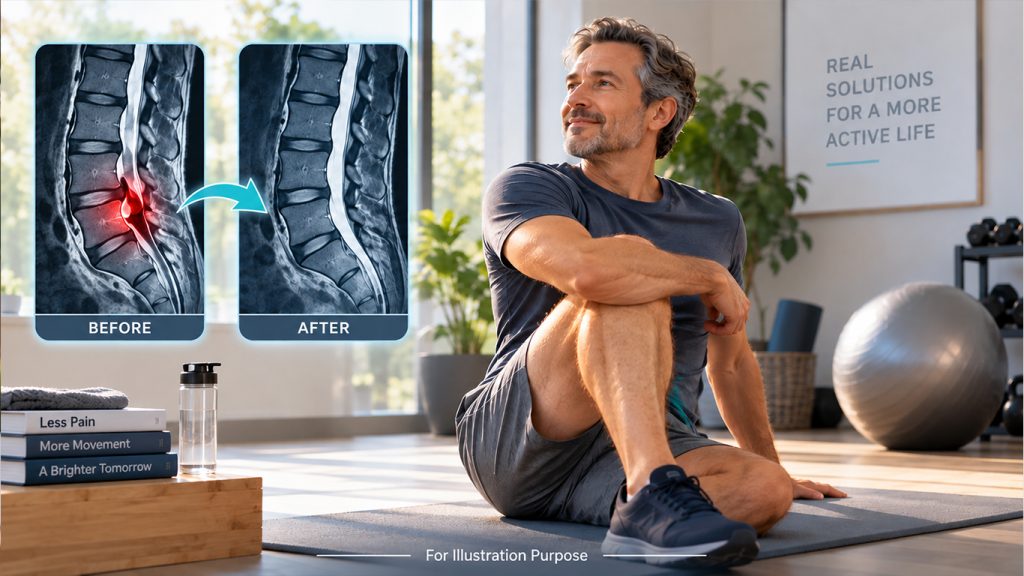
Spinal fusion joins two or more vertebrae, so they heal into one solid unit. Surgeons may use screws, rods, cages, and other implants to stabilise the spine during healing. Lumbar fusion surgery remains an important treatment for many spinal conditions, especially when the spine is severely unstable, damaged, or deformed.
However, fusion is not the only option for every patient.
For selected patients, dynamic stabilisation can support an unstable spinal segment while allowing controlled movement. A Dynamic Stabilisation System (DSS) is designed to limit excessive movement without completely stopping movement at the treated level, and there are now improved second generation DSS Systems, such as the HPS 2.0 included below.
This makes dynamic stabilisation one of several alternatives to spine fusion that a specialist may consider after reviewing your symptoms and scans.
Why Do Patients Want to Avoid Spinal Fusion?
The spine is designed to move. Each spinal segment helps you bend, turn, and support everyday activities.
Fusion permanently stops movement at the treated level once the vertebrae heal together. This can be beneficial when stability is the main concern, but some patients may be suitable for a motion-preserving treatment instead.
If you are researching how to avoid spinal fusion, the better question is whether a non-fusion treatment is safe and suitable for your particular spine.
What Are the Trade-Offs of Spinal Fusion?
Fusion can provide strong and lasting stability, but it also changes how the spine moves and carries loads.
Some considerations include:
- The treated spinal level no longer moves after successful fusion.
- The way forces are distributed through the spine changes.
- Nearby spinal levels may experience different mechanical demands over time.
- Recovery varies depending on the procedure, number of levels treated, general health, and rehabilitation.
- More extensive reconstruction may be needed when there is significant instability or deformity.
These factors do not mean fusion is the wrong choice. For many patients, it remains the most appropriate treatment.
They simply explain why motion-preserving spine surgery may be considered when the patient’s condition allows it.
What Is a Dynamic Stabilisation System?
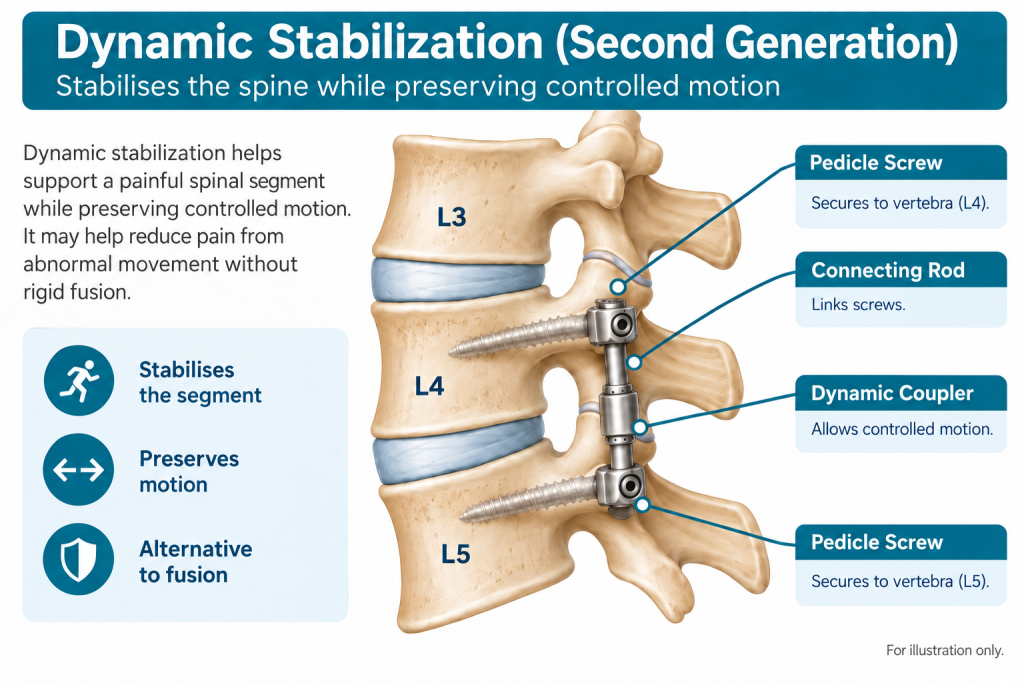
A DSS is a flexible spinal implant designed to support the spine while allowing controlled movement.
Unlike rigid fixation, a dynamic system is designed to limit excessive movement without completely locking the treated segment.
Depending on the system, dynamic pedicle screw rods and other components can be used to provide support while retaining healthy spine movement.
Dynamic stabilisation is different from artificial disc replacement. An artificial disc replaces a damaged disc, while dynamic stabilisation supports the existing spinal structures.
Neither option is suitable for everyone.
HPS 2.0: A Newer Dynamic Stabilisation Option
The HPS 2.0 Hybrid Performance System is a dynamic stabilisation system available for selected patients.
It uses pedicle screws, rods, and dynamic couplers to provide spinal support while allowing controlled movement. It may also be used in multi-level treatment and, in appropriate cases, alongside fusion.
HPS 2.0 is therefore not a replacement for fusion in every patient. It gives specialists another option to consider when preserving movement may be appropriate.
Your specialist will assess your diagnosis, spinal alignment, instability, discs, facet joints, bone quality, and imaging before recommending treatment.
How Does Dynamic Stabilisation Work?
A DSS supports the spine while allowing controlled movement.
Pedicle screws anchor the system to the vertebrae, while rods and dynamic components help control excessive movement. The exact configuration depends on your condition and the system being used.
The important question is not simply how the implant works, but whether DSS spine surgery is appropriate for your spine.
Dynamic Stabilisation vs Other Motion-Preserving Options
Dynamic stabilisation is one of several alternatives to spinal fusion. Depending on your condition, your specialist may also consider other motion-preserving treatments.
Artificial Disc Replacement
Artificial Disc Replacement (ADR) replaces a damaged spinal disc with an artificial disc designed to preserve movement.
It may be suitable for selected patients with disc-related problems. Your disc condition, spinal alignment, facet joints, bone health, previous surgery, and symptoms all play a role.
Total Disc Replacement
Total Disc Replacement (TDR) is another term for artificial disc replacement. It replaces a damaged disc with a prosthetic disc designed to allow movement.
It is not suitable for every type of disc degeneration or spinal instability.
Facet Joint Replacement
The facet joints help the spine move and remain stable. When these joints are badly damaged, total facet replacement may be considered in selected patients.
The aim is to provide support while preserving controlled movement.
Dynamic stabilisation, disc replacement, and facet replacement address different spinal problems. Your diagnosis should determine which option is considered.
When Is Spinal Fusion Still the Better Option?
Motion-preserving treatment is not suitable for everyone.
Severe instability, advanced spinal collapse, significant deformity, fractures, infection, or certain forms of spondylolisthesis may require a more rigid reconstruction.
For example, HPS patient information identifies degenerative spondylolisthesis greater than Grade 1 and severe instability as situations where dynamic stabilisation should not be used.
In these cases, fusion may provide the stability needed to restore alignment and treat the underlying problem.
The goal is not to avoid fusion at all costs. It is to choose the treatment that best fits your condition.
Could Dynamic Stabilisation Be Right for You?
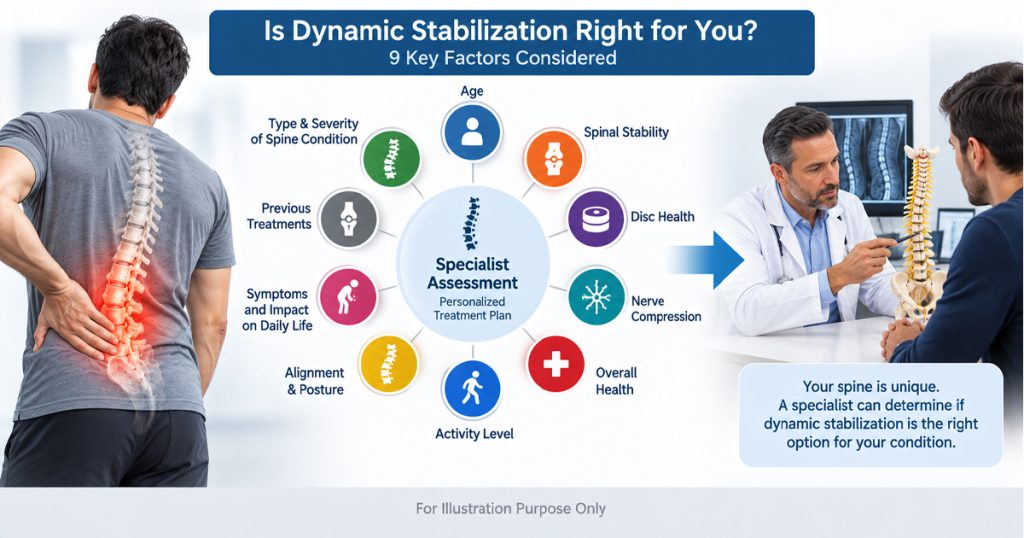
If you are searching for non-fusion stabilisation spine treatment, start with your diagnosis rather than a particular implant.
Your specialist may assess:
- The cause and location of your pain
- Whether nerves are compressed
- Spinal stability and alignment
- The condition of your discs and facet joints
- The degree and type of spondylolisthesis, if present
- Bone quality
- The number of affected spinal levels
- Previous spinal surgery
- Your overall health
MRI, CT, X-rays, and other imaging can help your specialist understand the condition and movement of your spine.
The aim is to find the most appropriate DSS or spinal fusion surgery that safely addresses your spinal problem while preserving movement where possible.
Take the First Step Toward a Personalised Spine Assessment
Choosing spine surgery is an important decision, and avoiding fusion should never mean compromising on safe or effective treatment. For the right patient, a dynamic stabilisation system and other motion-preserving procedures may offer an alternative while maintaining controlled movement.
The key is finding out what is appropriate for your spine.
For international patients, Spine Connection helps you access experienced German and Thai spine specialists, who can make it easier to explore different treatment options for you. You can also receive support with specialist coordination, hospital arrangements, travel planning, rehabilitation, and follow-up.
Send your medical records and latest spinal scans for specialist review. Get a personalised assessment from an experienced spine specialist and find out whether dynamic stabilisation, HPS 2.0, or another alternative to spinal fusion could be suitable for you.
Send your medical records and spinal imaging for specialist review now.
FAQs
Is dynamic stabilisation the same as spinal fusion?
No. Fusion joins vertebrae together so the treated level becomes one solid unit. Dynamic stabilisation supports the spine while allowing controlled movement.
What is the HPS 2.0 Hybrid Performance System?
HPS 2.0 is a Dynamic Stabilisation System that uses pedicle screws, rods, and dynamic couplers to support the spine while allowing controlled movement in selected patients. It can preserve stable motion at up to 2-levels in the lumbar spine.
Who may not be suitable for motion-preserving spine surgery?
Patients with severe instability, advanced spinal collapse, significant deformity, certain forms of spondylolisthesis, infection, fractures, or other structural problems may require fusion or another form of reconstruction.
Can dynamic stabilisation be used for spondylolisthesis?
It may be considered in selected cases, but not all types or grades of spondylolisthesis are suitable. Your specialist needs to assess the degree of slippage, spinal stability, discs, facet joints, alignment, and symptoms.
Is dynamic stabilisation better than spinal fusion?
Neither treatment is better for everyone. Dynamic stabilisation may be suitable when preserving controlled movement is appropriate, while fusion may be necessary when the spine needs rigid stabilisation. The right choice depends on your individual condition.

