Contact Us Today
 Begin My Assessment
 Watch Us On Youtube
 enquiries@spineconnection.org


Ankylosing spondylitis is a chronic inflammatory arthritis of the spine and the sacroiliac joints. It belongs to a family of conditions called spondyloarthritis, and is also known as axial spondyloarthritis or, in parts of Europe, Bechterew’s disease. It is strongly linked to a gene called HLA-B27. Unlike the wear-and-tear arthritis of older age, it is driven by the immune system, and it usually begins in early adulthood, most often in men.
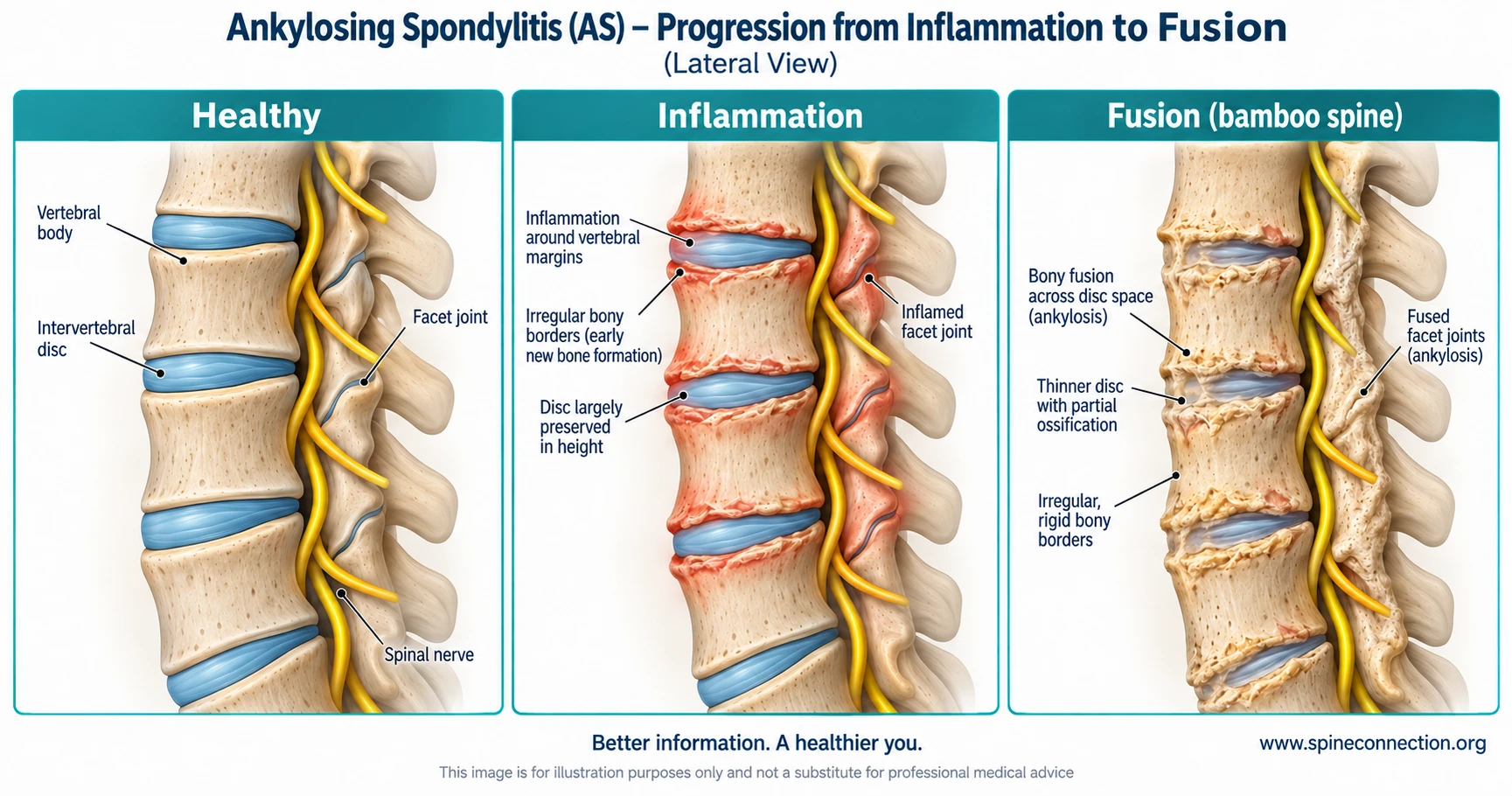
The hallmark of ankylosing spondylitis is inflammatory back pain, which behaves differently from ordinary mechanical back pain. Rather than improving with rest, it is typically worse after inactivity and improves with movement or exercise. Symptoms usually begin gradually before the age of 40 and may include prolonged morning stiffness, pain that wakes a person during the second half of the night, and deep pain in the lower back or buttocks arising from the sacroiliac joints.
Over time, the stiffness can spread up the spine, reducing how far a person can bend and turn and, where the joints between the ribs and spine are involved, how far the chest can expand. Fatigue is common. Because it is a whole-body inflammatory disease, it can also involve the eyes (a painful red eye, from uveitis), the bowel, and the skin, all worth mentioning to the rheumatologist.
One important point as the disease advances: a spine that has fused becomes rigid and often thin-boned, which makes it brittle. A fused spine can fracture from a fall, and those fractures are serious. This is covered in the surgery section, and it is why any new, severe, or changed back or neck pain after even a minor knock should be evaluated promptly.