Cover Top Placeholder

Ligament Injuries

Cover Middle Accent
Cover Bottom Height Engine
Last updated:

What is a ligament injury?

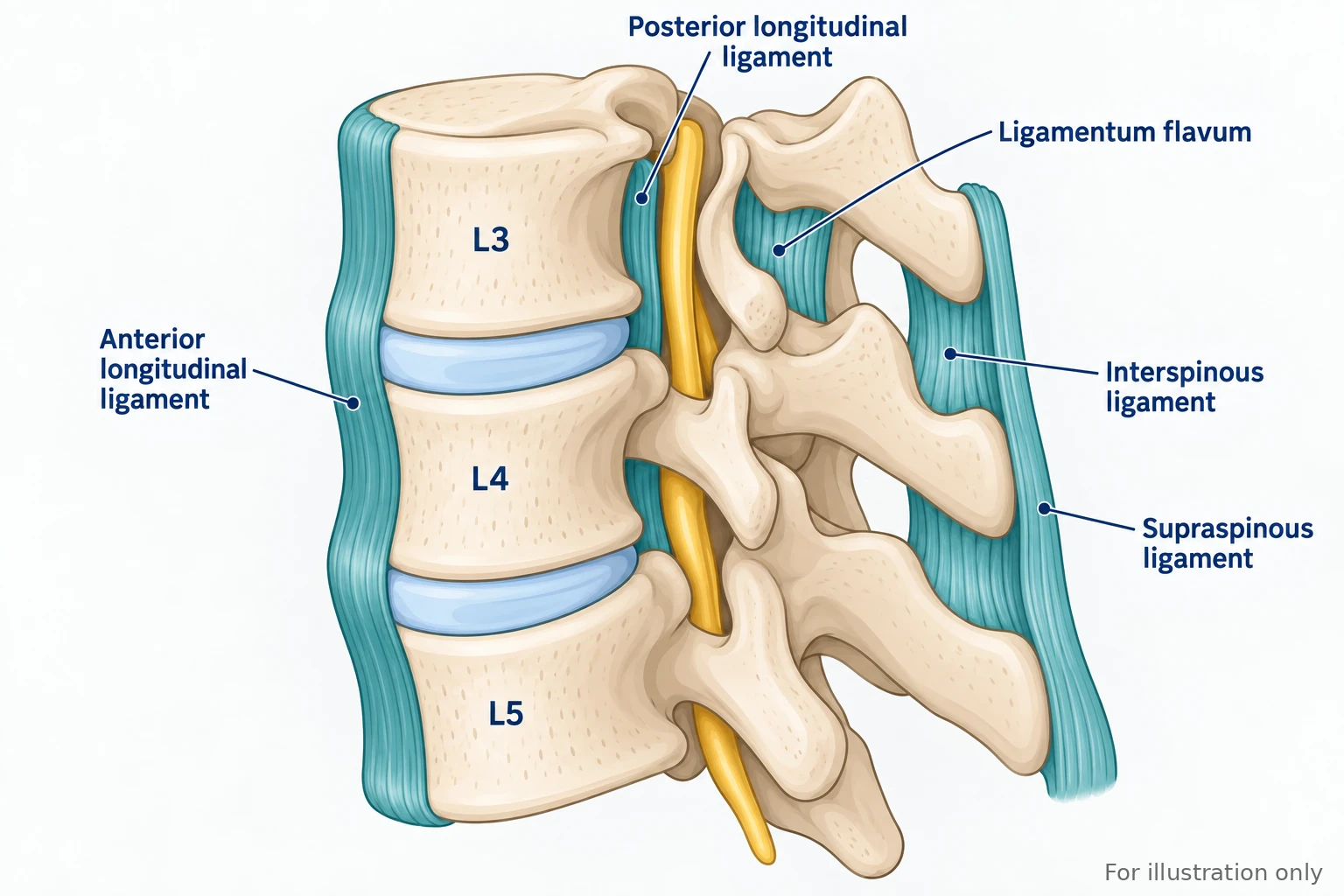
Ligaments are the tough bands of tissue that hold the vertebrae together and keep the spine stable as it moves. The main ones are the anterior and posterior longitudinal ligaments which run the length of the spine at the front and back of the vertebral bodies, the ligamentum flavum which lines the back of the spinal canal and the interspinous and supraspinous ligaments, which connect the bony projections you can feel down the middle of your back. A ligament injury, often called a sprain, happens when one of these bands is overstretched or torn, usually by a sudden force. Most spinal ligament injuries are minor, settle with time and the right care, and never need surgery.

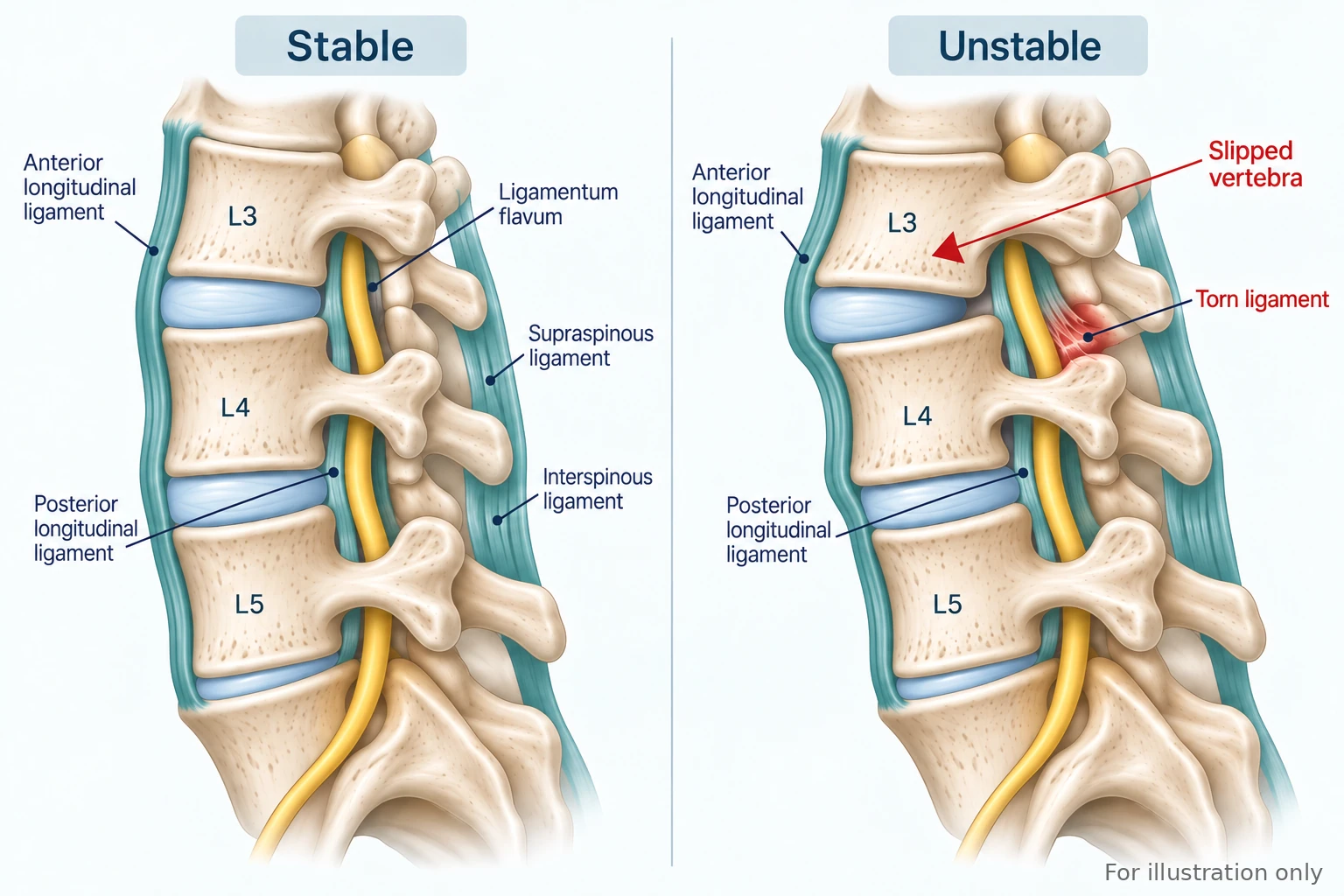
Ligaments matter because they are part of what keeps the spine stable. A minor sprain heals, and the spine stays stable. A more serious tear, or long-term wear that stretches the ligaments, can leave a segment of the spine moving more than it should. That instability is what occasionally needs more than rest.
What does a ligament injury feel like?

The usual symptoms are pain and stiffness in the injured part of the back or neck, often with muscle spasm as the surrounding muscles tighten to protect the area. The pain is typically worse with movement and eases with rest, and it may be sharp at first before settling to a dull ache. A familiar example is the neck pain and stiffness that follow a car accident, known as whiplash, which usually eases over the following weeks.

Some symptoms need urgent assessment rather than waiting: numbness, tingling, or weakness in the arms or legs, difficulty walking, or any loss of bladder or bowel control. After significant trauma, neck or back pain should be checked properly before it is assumed to be only a sprain.

What causes ligament injuries?

Spinal ligaments are injured in a few ways:

  • Sudden trauma: a fall or a sports impact can overstretch or tear a ligament in the back or neck.
  • Whiplash: the rapid back-and-forth movement of the neck in a motor vehicle accident, often a rear-end car accident, is one of the most common ways spinal ligaments are sprained. Most whiplash is a soft-tissue injury that settles, but a high-energy collision can do more serious damage.
  • Repetitive strain and posture: lifting badly, or holding a poor posture for long periods, loads the ligaments over and over, and over time this can strain and weaken them.
  • Degeneration: as the spine ages and its discs lose height, the ligaments can slacken and lose some of their hold, which is part of how a segment becomes loose.

How are ligament injuries diagnosed?

Most ligament sprains are diagnosed from the history and a physical examination, and a minor sprain often shows nothing abnormal on a scan. Imaging is used mainly to rule out more serious injury: an X-ray or CT scan to check for a fracture, and an MRI, which can show damage to the main stabilising ligaments and whether a segment has become unstable. After significant trauma medical imaging is very important, because a serious ligament injury can be present even when the bones look intact.

How are ligament injuries treated?

Nearly all spinal ligament injuries are treated without surgery, and most heal on their own with time.

  • Early care: a short period of relative rest, pain relief, then a return to gentle movement. Prolonged rest is not helpful; early, guided activity gives the best recovery.
  • Rehabilitation: physiotherapy to restore movement and strengthen the muscles that support and protect the spine is the main treatment, and it is what most people need. We can arrange structured spinal rehabilitation where it helps.
  • Time: depending on whether a ligament was mildly stretched or more badly torn, a mild overstretch usually settles in two to four weeks, a partial tear in six to twelve weeks, and a more significant tear can take several months. Most people recover fully. What does not resolve on its own is instability, if the injury has left a segment moving abnormally.

When is a ligament injury more than a sprain?

Occasionally a ligament injury is not just a sprain. Two situations are worth knowing about, because they can need more than rest.

  • Instability after major trauma: a high-energy injury, such as a serious motor vehicle accident or a fall from height, can tear the main stabilising ligaments, leaving a segment of the spine unable to hold its position under load. This is a serious injury that needs proper assessment and, in some cases, surgery to stabilise the segment.
  • Instability from long-term wear: over years, degeneration can stretch and weaken the ligaments enough that a vertebra begins to slip, or a segment moves abnormally. Where that instability is causing pain or pressing on nerves and has not settled with conservative care, stabilising the segment is one of the options.

In both, the issue is not the sprain itself but the instability it leaves behind. Working out whether a segment is genuinely unstable, and whether that instability is the cause of the symptoms is most important. This is the point at which a spine specialist should review the imaging to determine if medical treatment is recommended.

Frequently Asked Questions

Yes, the spine is held together by several. The anterior and posterior longitudinal ligaments run the length of the spine at the front and back of the vertebral bodies. The ligamentum flavum lines the back of the spinal canal. The interspinous and supraspinous ligaments connect the bony projections you can feel down the middle of your back. Together they keep the spine stable as it moves.

Yes. Most spinal ligament injuries are overstretching (a sprain) rather than a complete tear, and these settle with time and rehabilitation. A significant tear usually follows higher-energy trauma such as a serious car accident or a fall from height. The concern with a major tear is not the tear itself but whether it has left a segment of the spine unable to hold its position under load.

Pain and stiffness in the injured area, often with muscle spasm, typically worse with movement and easier with rest. The pain may be sharp initially before settling to a dull ache. Numbness, tingling or weakness in the arms or legs, difficulty walking, or any loss of bladder or bowel control are different and need urgent assessment. Rhose suggest nerve involvement rather than a simple ligament injury.

It depends on how badly it was damaged. A mild overstretch usually settles in two to four weeks. A partial tear can take six to twelve weeks. A more significant tear may take several months, and recovery depends as much on rehabilitation as on time. Most people recover fully. What does not improve on its own is instability, if the injury has left a segment moving abnormally.

Held in a slouched position for long periods, ligaments are put under sustained stretch, and over time they lengthen and lose some of their supporting tension – in a process sometimes called creep. They do not tear, but they become less effective at holding the spine, which leaves the muscles doing more work and the spine less protected. This is reversible with posture work and strengthening.

Usually, yes. Whiplash is the rapid back-and-forth movement of the neck in a collision, most often a rear-end car accident, and it typically overstretches the neck’s soft tissues including the ligaments. Most whiplash is a soft-tissue injury that settles over weeks with early movement and rehabilitation. A high-energy collision can do more serious damage, which is why significant trauma warrants proper imaging.

When it has left the spine unstable. A major tear after high-energy trauma can leave a segment unable to hold its position, which is a serious injury needing proper assessment and sometimes surgical stabilisation. Separately, long-term degeneration can stretch the ligaments enough that a vertebra begins to slip. In both cases the issue is the instability, not the original sprain.

Not settling, or worried about instability?

Most ligament injuries need nothing more than time and good rehabilitation. If yours has not settled, or a scan has raised the question of instability, it is worth a closer look. Our specialists in Germany and Thailand can review your imaging and tell you honestly whether it is a matter of continued rehabilitation, or whether a segment is unstable and needs stabilising.

Sources

  1. Cervical Dislocation. StatPearls (updated 2024). (The posterior ligamentous complex is a critical stabiliser of the spine; trauma ranges from ligament sprain to tear to instability, and treatment depends on the extent of the soft-tissue and bone injury.) (https://www.ncbi.nlm.nih.gov/books/NBK557528/)
  2. Mechanical Back Strain. StatPearls (updated 2026). (Most back strains follow a benign course, resolving over days to weeks with conservative management.) (https://www.ncbi.nlm.nih.gov/books/NBK542314/)
  3. Cervical Sprain. StatPearls (updated 2023). (Whiplash-associated disorders are soft-tissue injuries managed with early mobilisation and activity; a minority become chronic.) (https://pubmed.ncbi.nlm.nih.gov/31082060/)
We're here
to help.
Leave your details and we will contact you to answer your questions.

Get a Spine Specialist's Opinion for Your Ligament Injuries

Leave your details and we will contact you to answer your questions. We're here to help.


Join Our Youtube Channel

Watch videos showcasing the latest technologies and surgery techniques, and keep up to date with patient stories from around the globe.