 Contact Us Today
 Begin My Assessment
 Watch Us On Youtube
 enquiries@spineconnection.org



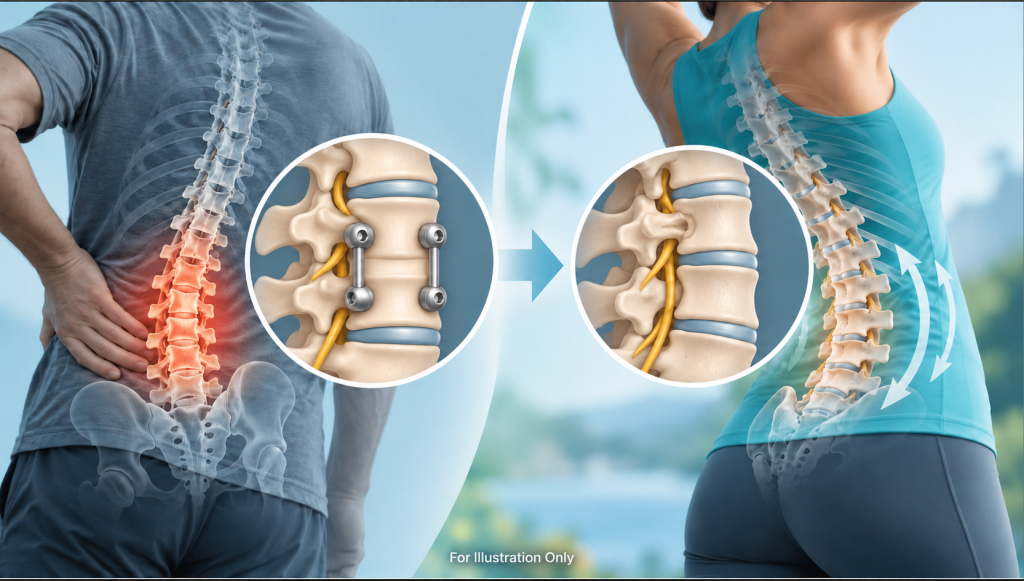
Your back hurts, and a spine fusion has been recommended for you. Or you already have one, and pain still limits your work, sleep, and family time. Now you want to know if you are eligible for fusion reversal surgery or not. We hope the following article is helpful.
A normal spinal fusion is surgery that joins two or more vertebrae, so they heal into one solid unit. Surgeons perform fusions in the neck, middle, or lower back. Once bone heals across the joined level, doctors consider the fusion irreversible because the level no longer moves.
However, if the fusion has occurred successfully, and you have new pain develop, you still have good options, including at levels next to a fusion. Spine Connection specialists favour motion restoration spine surgery when the spine allows. Let’s discuss it in detail.
What Happens to the Spine in a Fusion?
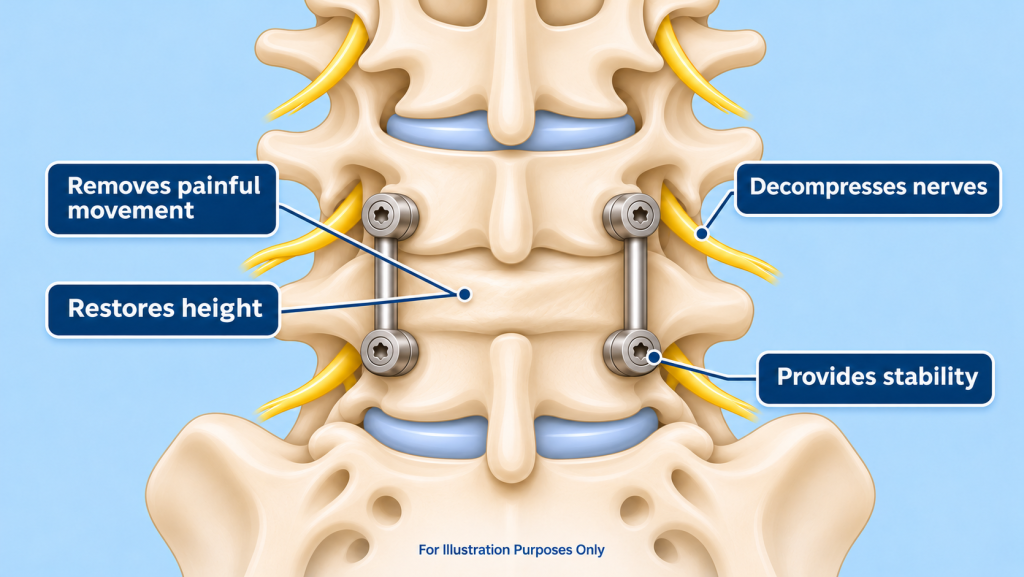
Surgeons use rods, screws, cages, and bone grafts to hold the vertebrae in place. Over time, new bone grows between them and joins them together. A fusion aims to accomplish four things for the right patient:
- Removes painful movement
- Restores spinal height
- Decompresses nerves
- Provides stability, alignment and curvature
Some patients need all four. Restoring full movement in a collapsed or unstable spine sometimes causes more pain. When there is persistent pain after spine surgery, a reconstructive fusion could be the safest choice. Traditional open fusion techniques also typically need six months or more of recovery.
Spine Connection starts from one idea. Your spine is a mobile organ, and a fusion is an irreversible interference with this. So the goal is clear. Your surgeon decides if a failed fusion revision surgery can be fixed with a motion-preserving solution instead, or if that area is not conducive to mobility anymore. Our partner surgeons in Germany and Thailand perform minimally invasive and robotic assisted fusions, disc replacements, facet replacements, and endoscopic decompressions. They stay unbiased and recommend their best surgery for your optimal outcome
Why a Fusion Is Considered Irreversible?
Once the bones heal together, the operated level becomes one solid unit. Movement at that level stops permanently. This is why fusion differs from motion restoration spine surgery, which keeps the level mobile.
Loss of movement changes the load on your spine. Neighbouring levels bend and twist more to make up for the stiff level. For example, a fusion at L5-S1 sends extra stress to the L4-L5 level above. Over the years, this extra stress can add to “post-fusion adjacent segment disease” and even require an extension of the fusion over time to treat these levels next to the fusion.
So can spinal fusion be reversed? Reversal is rare. Surgeons undo a fusion only in selected cases. fusions done from both the front and the back, are generally impossible to reverse. Solid bone healing also raises the risk of nerve damage, chronic pain, and instability if a surgeon tries to undo the fusion.
Spine Connection specialists regard fusion as a last line of defence. They choose fusion when a motion-preserving solution is not available. This view does not criticise fusion. Fusion helps many patients, and is deemed superior in certain cases. The question is choosing the right treatment for the right patient.
Fusion Reversal Surgery Alternatives for Patients Who Already Have a Fusion
A past fusion does not mean you must add another one. Your surgeon first checks the level next to the fusion. Here is what most surgeons would suggest.
- When a new disc is damaged and you are a suitable patient, Artificial Disc Replacement (ADR) is an option. The surgeon removes the damaged disc and places an artificial disc after fusion. This keeps movement at the new surgical level. This also avoids extending the rigid fusion.
- Total Facet Replacement is a second option. Surgeons consider this when the facet joints and or vertebral slippage cause most of your pain, and the spinal disc is still healthy and intact. An implant replaces the damaged joint and keeps motion.
- HPS 2.0/Dynamic Stabilisation is a third option for selected cases. This minimally invasive system uses flexible rods and screws to support the spine while preserving movement. The system also reduces the mechanical load on adjacent segments.
Some patients ask about converting an old cervical fusion to disc replacement. In rare cases, surgeons remove the fusion hardware and bone and place an artificial disc. Three conditions matter:
- The first surgery came from the front, such as a neck fusion called ACDF.
- The facet joints in the back stay intact and unfused.
- The fusion healed incompletely, a condition called pseudarthrosis, or the bone and hardware separate safely.
Insurance plans often call this conversion off-label or experimental, so patients can face high personal costs.
The team decides case by case. They review your scans, spinal alignment, stability, discs, facets, bone quality, symptoms, and previous surgery. Not every fusion patient qualifies for an artificial disc and facet joint replacement or motion-preserving procedure.
Why Get the Decision Right the First Time?
Once surgeons perform a fusion, reversing the fused segment is not often possible, and can be a very traumatic surgery. So you gain the most by asking questions about fusion reversal surgery before making a decision. When medically appropriate, consider motion-preserving options before you commit to permanent loss of movement. Three core alternatives exist:
- Artificial Disc Replacement (ADR)
- Total Facet Replacement
- HPS 2.0/Dynamic Stabilisation Systems (DSS)
At Spine Connection, we help you seek independent opinions from leading spine specialists in Germany and Thailand, compare suitable motion-preserving options, and understand when fusion offers the safer route. Our team also helps coordinate treatment arrangements, travel, and rehabilitation, with clear pricing for applicable packages.
Send your records for review and take the next step with informed guidance, tailored care, and a plan built around your needs.
FAQs
Is spinal fusion reversal possible?
Rarely. A solid fusion is generally considered irreversible, as breaking the bone apart would be too traumatic, and the facet joints are usually auto-fused and not conducive to mobility again.
Which fusions are reversible?
Fusions done from the front of the neck or spine, such as ACDF, are the main group, as long as the facet joints are intact, and not yet fused. Posterior fusions are generally impossible to reverse.
Does insurance cover converting a fusion to an artificial disc?
Often not. Many plans classify the conversion as off-label or experimental, so you face high personal costs. Ask for a quote before proceeding.
How do I get a specialist opinion in Germany or Thailand?
Send your scans and records to Spine Connection. Independent surgeons in both countries review them, and your concierge guides each step.

