 Contact Us Today
 Begin My Assessment
 Watch Us On Youtube
 enquiries@spineconnection.org


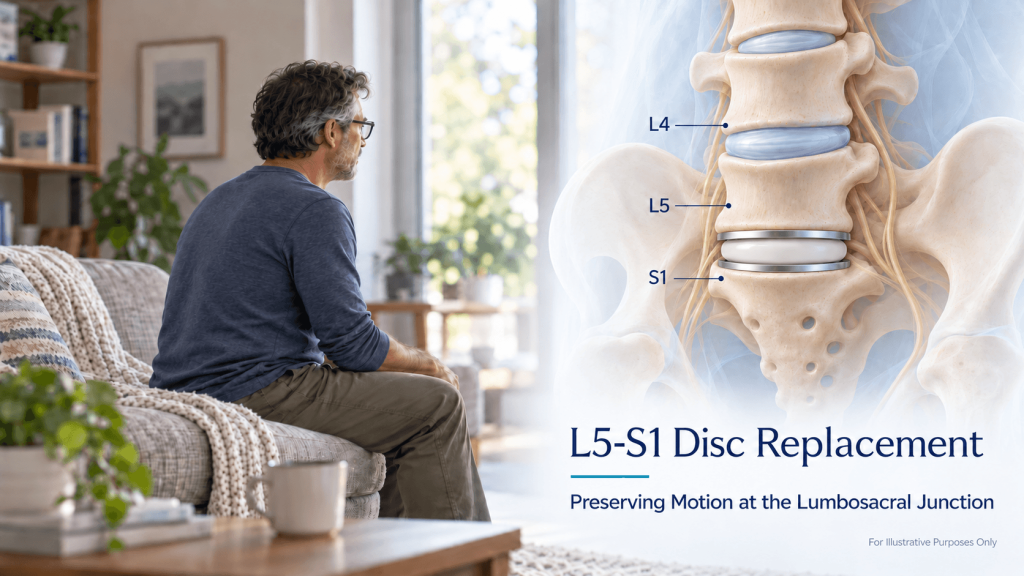
Small pads called discs sit between the bones in your back. These discs hold your bones together, soak up shock, and let your spine bend and twist. The L5-S1 disc sits at the very bottom of your spine, joining your last moving back bone to your tailbone area. This disc carries more weight and more movement than any other disc in your lower back. That is why doctors see this spine level wear out more than most other spots.
When this disc wears down, pain can spread through your lower back, hips, and legs. L5-S1 disc replacement treats this damage while your spine keeps moving the way it was intended.
Why the L5-S1 Level Is Different and What Causes It?
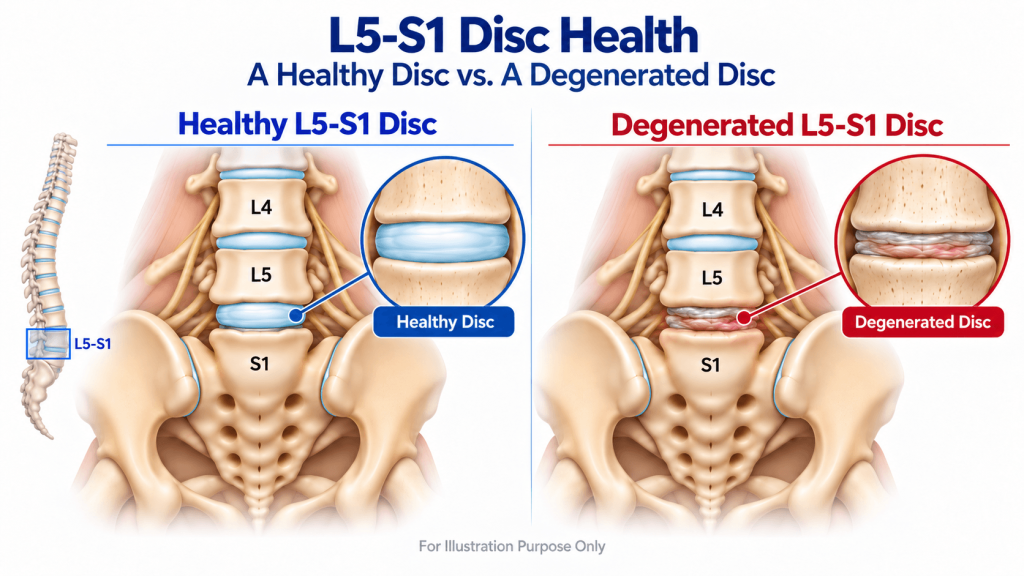
The L5-S1 level forms the true base of your spine. This spot sits right where your flexible lower back meets your fixed tailbone. Doctors see L5-S1, along with the level above it called L4-L5, as the most common spots needing treatment for worn-out discs, also called Degenerative Disc Disease (DDD).
Discs do not get blood flow like other body parts. So, once a disc becomes degenerative, your body cannot heal it well on its own. Daily pressure from standing, walking, and sitting slowly wears the disc down over time.
Age and repetitive movements wear the disc cushion down bit by bit. This wear can lead to small bone growths called bone spurs and a loss of disc height. A slipped or bulging disc at L5-S1 pushes backward into the space where your nerves travel. This pressure can pinch the nerves, causing sharp leg pain called sciatica.
Conservative Care Comes First
After diagnosing L5-S1 Degenerative Disc Disease (DDD), doctors usually ask you to try non-surgical care for six to twelve months before talking about surgery. Physical therapy, gentle exercise, and pain injections give many patients real relief without an operation.
Surgery stops being a choice when certain warning signs show up. These signs include a foot that drags when you walk, loss of bladder or bowel control, or a serious nerve problem called cauda equina syndrome. When these signs appear, your doctor moves surgery from optional to needed right away.
Why Patients Choose Motion Preservation Over Fusion?
Spinal fusion treats pain by locking two back bones together so they cannot move. This method helps many patients, though it comes with trade-offs.
Depending on the technique used, fusion often needs a longer recovery, sometimes past six months. The fused level loses all movement for good. Adjacent levels (L4-L5) in your spine take on extra stress as your body adjusts. Over the years, this extra stress raises your chance of new damage. Doctors call this problem “post-fusion adjacent segment disease”, and it sometimes leads to an extension of your fusion over time.
Younger, active people who want to avoid spinal fusion often choose artificial disc replacement instead. This choice fits people who want lasting relief while keeping their operated spine level mobile.
How L5-S1 Disc Replacement Works?
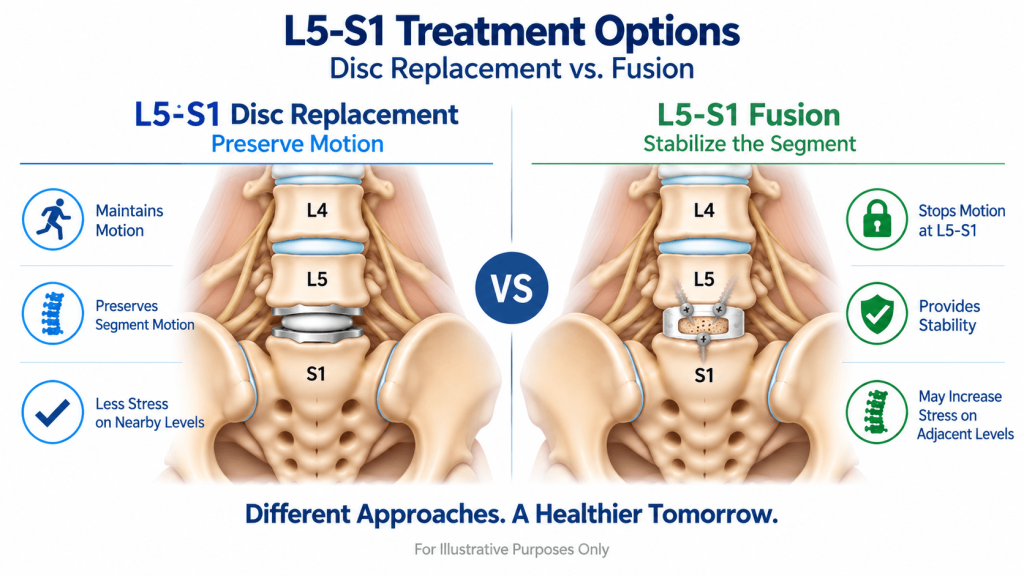
This advanced disc replacement is also called Total Disc Replacement (TDR). Your surgeon takes out the damaged disc fully, a step called a total discectomy, and puts in an artificial disc instead. Your surgeon reaches the disc through a small cut in your belly area, a path called the front (anterior) approach. This path is usually gentler on your muscles than the back approach used in many fusion surgeries.
This type of artificial disc replacement began in Germany back in the 1980’s. Surgeons there built the first devices, and the materials and designs have grown stronger and more precise since then.
For the right patient, L5-S1 Disc Replacement recovery is faster than traditional fusion. Your surgeon takes pressure off pinched nerves and brings back lost disc height, while your spine keeps its normal, controlled movement.
Disc Replacement vs ALIF
A surgery called ALIF, short for anterior lumbar interbody fusion, uses the same front path to reach your spine but locks the bones together instead of keeping them able to move. Disc replacement fits patients who want that same front path without losing movement at L5-S1. ALIF is the better pick if it’s discovered your vertebral bone quality is not strong, you have vertebral slippage, or if your facet joints at L5-S1 have too much arthritis.
Implant Technology Used at L5-S1
Modern artificial discs mimic your spine’s normal movement in up to six directions, including vertical compression or shock absorption. Resistance builds up slowly near the end of each movement, which protects the facet joints in your back and supports safer results when more than one level needs treatment.
Some implants use a fixed centre piece, which suits certain patients well. Newer designs also come with an angled edge built to match the natural curve found at L5-S1. Surgeons pick from several implant types based on your own spine shape, disc height, and alignment.
German specialists keep a full stock of implant choices right next to the operating room. This stock covers every size, height, angle, and bony anchoring. During surgery, your surgical team tests different options in real time to match the best implant to your spine. One single standard implant rarely fits every patient, and this careful setup reflects that fact.
When Disc Replacement Isn’t the Right Fit?
A lumbar artificial disc replacement sometimes helps patients who already had a fusion before. When an old fusion puts extra stress on an adjoining spine level, placing an implant there instead of extending the fusion further helps limit adjacent segment disease.
Not every patient qualifies for disc replacement. Healthy facet joints in your back and a properly aligned spine remain key needs, since L5-S1 surgery must restore your natural lower back curve the right way. Where disc replacement clearly won’t work, as it might cause more pain or instability, the surgeons will discuss an alternative treatment plan, for your safety and optimal outcome.
Choose Spine Connection for Your Disc Replacement
Your spine carries you through every part of your life, and your lowest disc works harder than any other. Before you choose L5-S1 fusion, get your scans reviewed by top experts. Get independent opinions from leading German neurosurgeons and orthopedic spine specialists who handle both non-surgical care and complex motion-preserving surgery.
At Spine Connection, you get several independent opinions from international neurosurgeons and orthopedic spine specialists at leading German and Thai hospitals. German disc replacement specialists offer fixed-price packages that cover your surgery and your rehabilitation together, with recovery support at Europe’s largest rehabilitation centre.
You get clear, upfront pricing. You get a dedicated support team that handles your travel and paperwork. You get implant technology matched closely to your own spine, not a one-size-fits-all choice. Begin My Assessment today, or reach out through Ask Our Doctors, and give the base of your spine the careful attention it deserves.
FAQs
What is L5-S1 disc replacement and how is it different from fusion?
L5-S1 disc replacement swaps your damaged disc for an artificial one that keeps moving with your spine. Fusion locks the bones together for good, removing all movement at that level. Either surgery may be most appropriate for your optimal outcome.
How long does the disc last after degenerative disc disease is treated with ADR at L5-S1?
Modern implants are built to be implanted for life. Most patients enjoy steady, stable function long after surgery. If your have spine symptoms again, please contact your surgeon, who will guide you.
Can disc replacement be done next to a previous spinal fusion?
Yes. Surgeons often place a disc implant at the spot right next to an earlier fusion. This step eases the extra stress there instead of extending the fusion further.
How long is L5-S1 disc replacement recovery compared to fusion?
Disc replacement patients can usually return to light duties at 3 months, and full duties at 12 months. This timeline is generally faster than traditional open fusion approaches (whilst retaining motion at the operated level). Physical therapy during this time rebuilds your strength and helps you return to daily life.

