 Contact Us Today
 Begin My Assessment
 Watch Us On Youtube
 enquiries@spineconnection.org


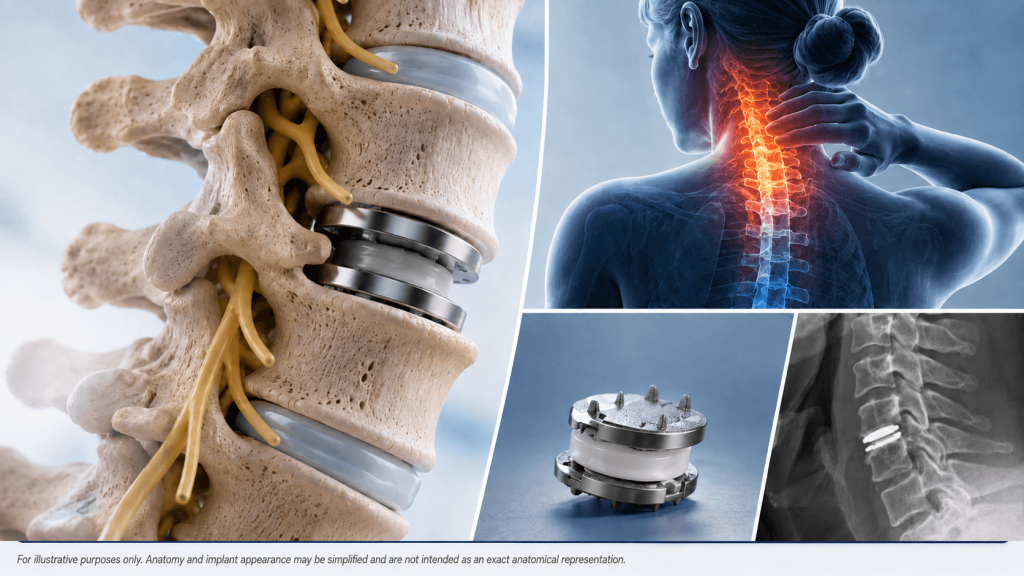
Neck pain from a damaged disc can greatly affect your quality of life. Nerve pain can radiate down your arm, creating sharp shooting sensations, numbness, and hand weakness. Arm pain and numbness often make simple tasks like driving, working on a computer, or turning your head become difficult. In cases like this, cervical disc replacement can offer a solution without ongoing decompression surgeries, or fusing your neck bones together.
Germany is recognised worldwide as a leading center for Artificial Disc Replacement (ADR), sometimes referred to as Total Disc Replacement (TDR), with more than three decades of experience and among the highest case volumes globally. German surgeons have played a significant role in the development of motion-preserving spine surgery, and continue to work with a broad range of modern implant systems including the CP-ESP, Prodisc C, Prodisc C NOVA, Prodisc C VIVO, and the Baguera C. As every patient has a unique anatomy, different implant models can be used to match each spine.
Today we will explain how motion-preserving neck surgery works, how it compares to traditional fusion surgery, and who qualifies for treatment.
What Is Cervical Disc Replacement?
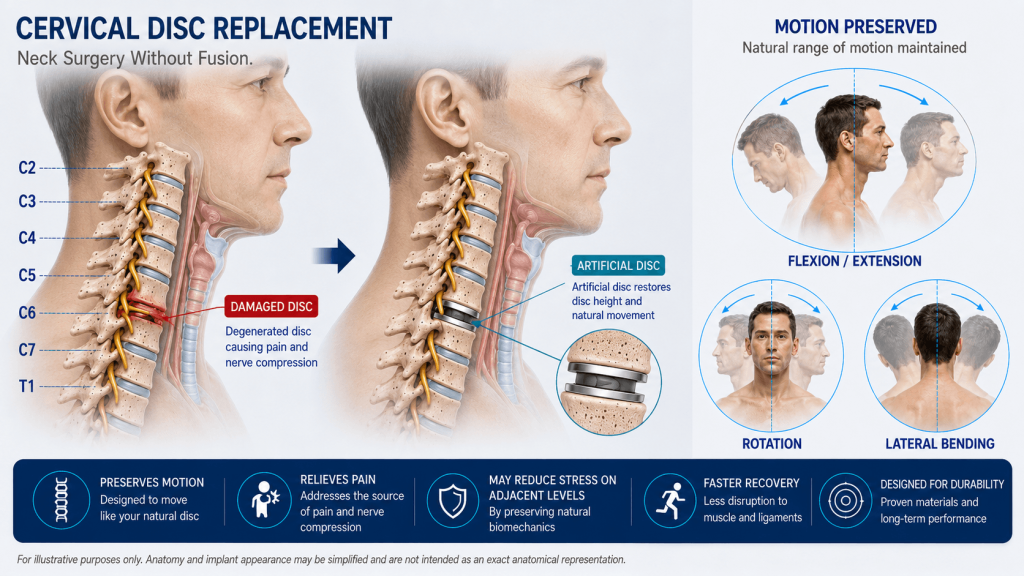
Spinal arthroplasty, or Artificial Disc Replacement (ADR), is a motion-preserving surgery. Your surgeon removes the damaged neck disc, prepares the vertebral endplates, distracts the affected spine level, and inserts an artificial implant in its place. Unlike traditional spine fusion surgery, known as ACDF, this method keeps your spine flexible. This lowers stress on the discs above and below the surgery site, and supports a faster return to daily activities.
Patients searching for an ACDF alternative often land on cervical artificial disc replacement as their answer. The goal is simple – fix the damaged disc while keeping your neck and head moving.
How the Procedure Works?
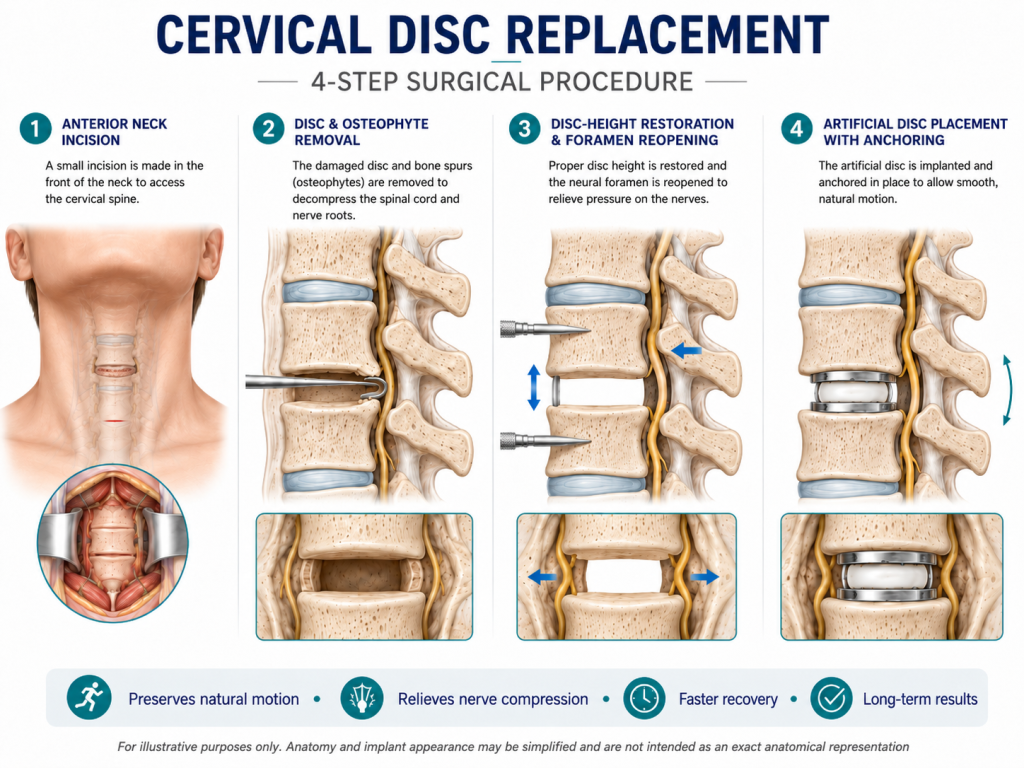
Surgeons perform cervical disc arthroplasty through a clean, carefully planned process. It follows four clear steps.
Step 1: Front Incision
The surgeon makes a small horizontal cut at the front of your neck. Entering from the front allows direct access to the spine without cutting through dense muscles and soft tissues behind.
Step 2: Disc Removal
The surgeon removes the damaged, bulging, or worn-out disc. The surgeon also clears away bone spurs to free pinched nerves and relieve pressure on the spinal cord.
Step 3: Height Restoration
Removing the broken disc leaves an empty space. The surgeon opens the space back to its natural height. Restoring this height opens the side channels called neuroforamina, the openings where nerves exit the spine.
Step 4: Implant Placement
The surgeon inserts an artificial disc device into the empty space. This implant uses metal plates with different anchoring methods (depending on the implant type) to achieve primary fixation. If an extremely experienced Disc Replacement surgeon is performing your surgery, they will have an inventory room next to the operating theater with many types of disc models available to match the optimal implant to your unique anatomy. Cervical Disc Replacement isn’t a “one size fits all” surgery, and the correct device supports motion restoration from the outset.
Artificial Disc Replacement vs Spine Fusion Surgery
Fusion surgery locks two neck bones together permanently. However, artificial disc replacement neck surgery takes a different path. Here is how the two compare.
Natural Neck Mobility
Spinal fusion surgery stops all movement at the treated neck joint. CDR preserves motion at the operated neck level, allowing bending, tilting and twisting movements. Preserving motion helps you maintain comfortable daily movement.
Protection for Neighboring Discs
Locking neck bones together with fusion surgery transfers extra stress to the discs above and below the surgical site. When these discs become damaged, the official term is called “post-fusion adjacent segment disease”. This extra stress causes these discs to wear down faster over time, especially if they are already showing signs of degeneration, and this can lead to an extension of the rigid fusion. Sometimes we have enquiries from patients who have had their entire neck fused due to this exact situation, and they can no longer look over their shoulder to change lanes or reverse when driving. Artificial disc replacement absorbs movement and pressure, protecting adjacent discs from early breakdown, and usually resulting in less surgery.
Faster Recovery Times
Fusion surgery requires 3-4 months for bones to start growing together solidly. Patients often wear a restrictive neck brace during this healing phase. Disc replacement implants do not need bone fusion to work. Patients often leave the hospital and return to light daily duties after 6 weeks, and full duties after 12 weeks, without wearing a neck collar. Note: As every patient is uniquely different, please ask your surgeon about your recovery.
Are You a Good Candidate for Spinal Arthroplasty?
Some patients are good candidates for Artificial disc replacement, while others are outside of the treatment window. You may be a good candidate for Total Disc Replacement if you match these points.
- Single or Multi-level Disc Damage: You have one to four damaged neck discs causing severe arm pain, tingling, or weakness.
- Failed Conservative Care: Your symptoms persist after diligently committing to rest, guided physical therapy, and medications or injections (if recommended).
- Risk of Permanent Nerve Damage: You have severe nerve or spinal cord stenosis (compression) and are at risk of permanent nerve damage without decompression surgery.
- Preserved Bone Health: You have suitable bone density without severe osteoporosis, spinal instability, vertebral slippage, or advanced facet joint arthritis.
Your surgeon confirms your exact fit through scans and a full review of your neck condition.
Disc Replacement and Other Common Levels
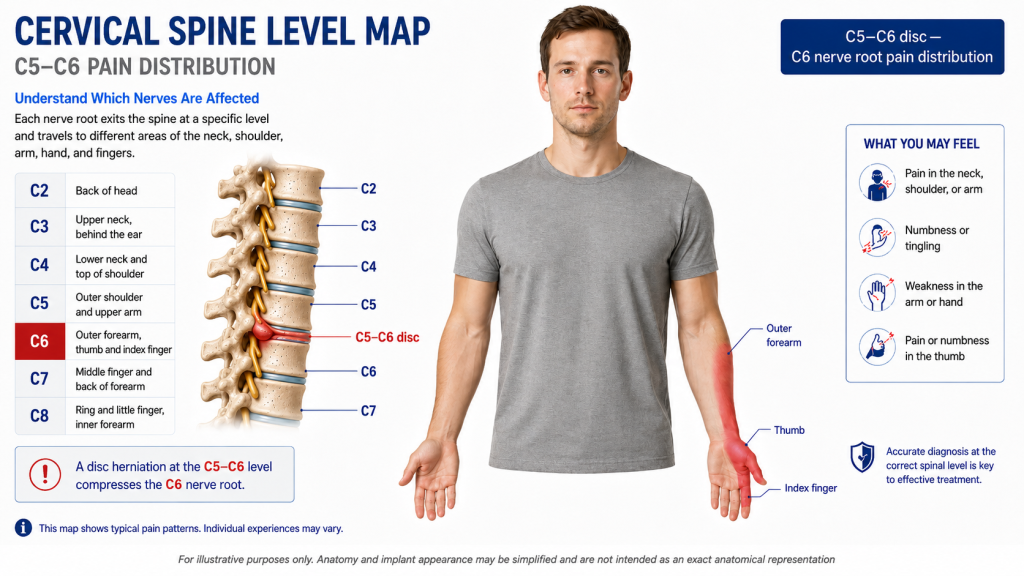
The C5-C6 level is the most common area for neck disc herniations. This joint sits near the base of your neck and supports heavy movement.
A damaged C5-C6 disc causes pain, weakness, and numbness that can travel down your shoulder, arm, bicep, and thumb. Performing a C5-C6 disc replacement removes nerve compression, restores arm strength, and preserves normal neck and head movement. Surgeons can also perform two-level disc replacement or combine hybrid procedures like artificial disc replacement and fusion in a hybrid surgery, depending on your specific anatomical needs.
You Deserve a Clear Path Forward
Living with constant neck and arm pain limits your personal independence and daily comfort. You do not have to accept permanent neck stiffness or face long health system delays.
Send your scans to the German Spine Centre at Spine Connection, and hear back from Germany’s Cervical Disc Replacement experts, who will explain your options. Compare cervical disc replacement against spinal fusion surgery with a fixed package price confirmed upfront, with no waiting list standing between you and relief. A dedicated patient guide stays with you from your first scan review, through your surgery in Germany and recovery at home.
Send your recent MRI and X-Rays to our expert team today to confirm your eligibility for motion-preserving neck surgery.
Frequently Asked Questions
What is cervical disc replacement?
Cervical disc replacement removes a damaged neck disc and inserts an artificial implant. This keeps your neck flexible instead of fusing the bones together.
Is cervical disc replacement better than ACDF?
It depends on each individual case. Cervical disc replacement restores natural neck movement and lowers stress on nearby discs. Spinal fusion surgery suits patients needing maximum stability. Your experienced surgeon compares both options against your clinical symptoms, imaging results, and surgery goals.
How long does recovery take after cervical disc replacement?
Most patients are up and walking in the first 24 hours after surgery. Patients can generally return to light duties after 6 weeks, and full duties after 12 weeks. Your surgeon will provide personalized guidance based on your specific case.
Am I a candidate for cervical disc arthroplasty?
You may qualify if you have single or multi-level cervical disc damage or degeneration, arm pain or numbness, with no severe bone disease or major spine instability. Our surgeons regularly perform Cervical Disc Arthroplasty at up to 4 levels in the Neck. Your surgeon will confirm this through evaluating your case.
Scientific References
- De Jesus O. Degenerative Cervical Disc Herniation: Prevalence of Affected Cervical Level in a Hispanic Population in Puerto Rico. World Neurosurg. 2024;181:e776-e779.
- Quinto ES Jr, Paisner ND, Huish EG Jr, Senegor M. Ten-year outcomes of cervical disc arthroplasty versus anterior cervical discectomy and fusion: a systematic review with meta-analysis. Spine (Phila Pa 1976). 2024;49(7):463-469.
- Gornet MF, Schranck FW, Sorensen KM, Copay AG. Multilevel Cervical Disc Arthroplasty: Long-Term Outcomes at 3 and 4 Levels. Int J Spine Surg. 2020;14(s2):S41-S49.
- Phan K, Xu J, Schultz K, Alvi MA, Lu VM, Kerezoudis P, Maloney PR, Murphy ME, Mobbs RJ, Bydon M. Full-endoscopic versus micro-endoscopic and open discectomy: A systematic review and meta-analysis of outcomes and complications. Clin Neurol Neurosurg. 2017;154:1-12.
- Bydon M, Xu R, Macki M, et al. Adjacent segment disease after anterior cervical discectomy and fusion in a large series. Neurosurgery. 2014;74(2):139-146.
- De Jesus O. Degenerative Cervical Disc Herniation: Prevalence of Affected Cervical Level in a Hispanic Population in Puerto Rico. World Neurosurg. 2024;181:e776-e779.
- Anderson PA, Sasso RC, Hipp J, Norvell DC, Raich A, Hashimoto R. Kinematics of the cervical adjacent segments after disc arthroplasty compared with anterior discectomy and fusion: a systematic review and meta-analysis. Spine (Phila Pa 1976). 2012;37(22 Suppl):S85-S95.

