 Contact Us Today
 Begin My Assessment
 Watch Us On Youtube
 enquiries@spineconnection.org


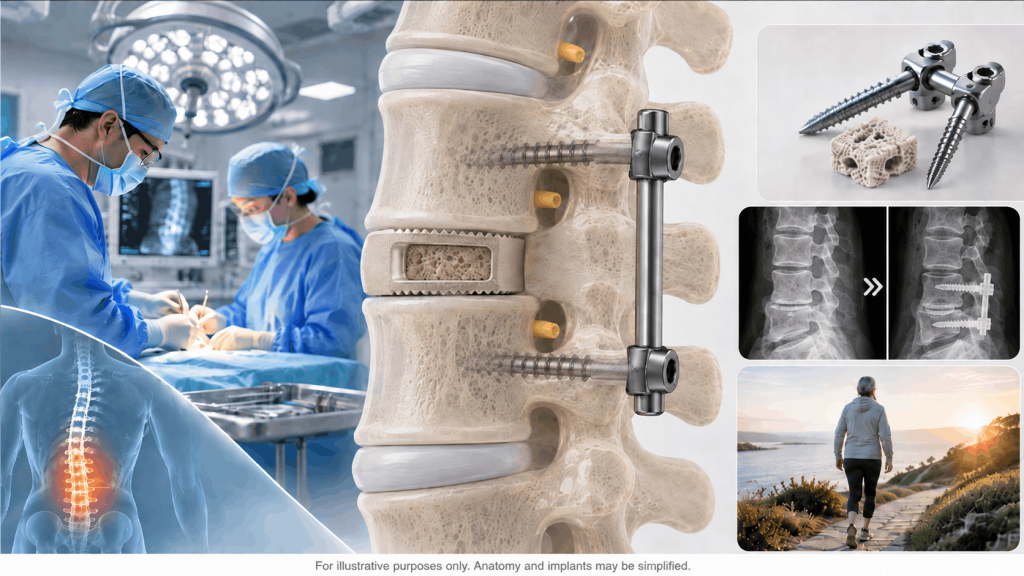
You have lived with back or neck pain for months, maybe years. A doctor said the word “fusion.” Now you have questions. What does spinal fusion surgery involve? Will the surgery work? What do you give up? Let our experts answer each question, so you know what to expect before you decide.
People are also concerned about fusion surgery abroad, in places like Germany or Thailand. Many back or neck pain patients are opting for these countries as spine surgery destinations these days. Why? Because between them, these countries offer a mixture of major cost savings, minimal waiting times, and access to advanced techniques that might not be available at home.
Now, let us understand the complete dynamics of fusion surgery.
What Spinal Fusion Surgery Actually Does?
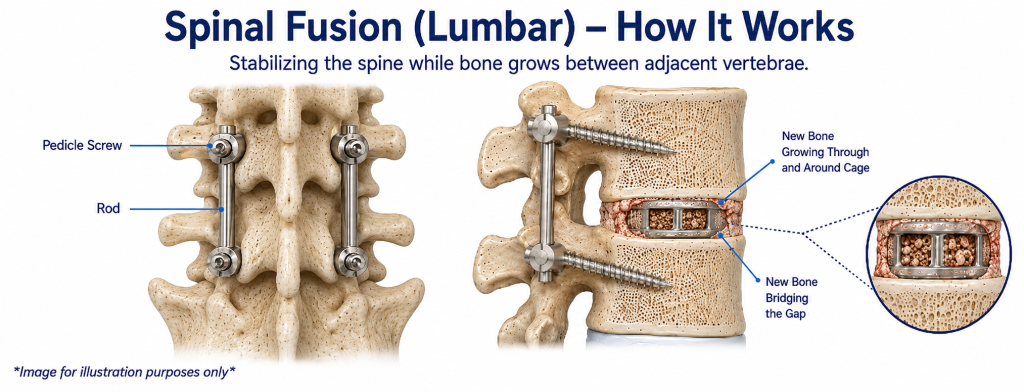
Spinal fusion surgery aims to join two or more vertebrae into one solid piece of bone. Traditionally, surgeons use bone grafts, rods, and screws to hold the vertebrae together while new bone grows across the gap. In modern times, surgeons also include an intervertebral fusion cage to increase the chance of successful fusion. Once healed, the joined vertebrae no longer move against each other. This stops the painful motion that comes from damaged discs, worn joints, or an unstable spine.
Fusion is not a quick fix. Solid bone healing takes 3 to 12 months. Full recovery takes patience and commitment.
Common Types of Spinal Fusion Surgery
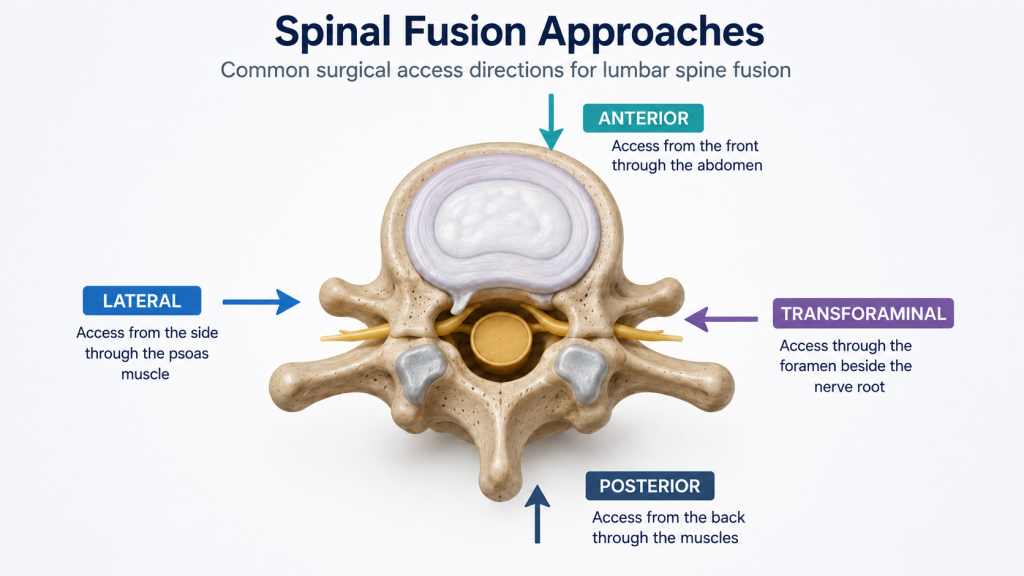
Surgeons choose a fusion type based on where the problem sits in your spine, how they need to reach it, and the techniques they are trained and experienced in. Here are the main approaches.
Anterior Cervical Discectomy and Fusion (ACDF)
ACDF treats problems in the neck. The surgeon works through the front of the neck to remove a damaged disc and relieve pressure on the spinal cord or nerves. This approach is common for herniated discs and pinched nerves in the cervical spine.
Anterior Lumbar Interbody Fusion (ALIF)
ALIF treats the lower back. The surgeon reaches the lumbar spine through the abdomen. This route avoids cutting through back muscles, which often means less muscle damage and a smoother early recovery.
Posterior Lumbar Approaches (TLIF & PLIF)
Transforaminal Lumbar Interbody Fusion (TLIF) and Posterior Lumbar Interbody Fusion (PLIF) both reach the spine from the back. Surgeons use these approaches to stabilize a specific segment and remove pressure on nearby nerves. Both techniques are now available by minimally invasive approaches with less muscle and ligament trauma, although not all surgeons are experienced in these newer techniques.
When patients compare TLIF vs ALIF, the choice usually comes down to anatomy and the exact problem being treated. ALIF avoids back muscle and ligament disruption because it enters from the front. TLIF gives surgeons direct access to nerve roots from the back, which may help in cases with significant nerve compression. Your surgical team will match the approach to your scans and symptoms.
Important: A previous anterior approach (ALIF) is usually a contraindication for a future motion-preserving Disc Replacement instead of a fusion extension, if post-fusion adjacent segment disease develops. Planning for the future in young patients should also be a part of the initial surgery planning.
Lateral Approaches
LLIF and XLIF (Lateral and Extreme Lateral Interbody Fusion) reach the spine from the side of the body. This route spares back muscles and major nerves that run along the back of the spine, which can lower trauma during surgery.
Spinal Surgery Success Rate and Bone Healing
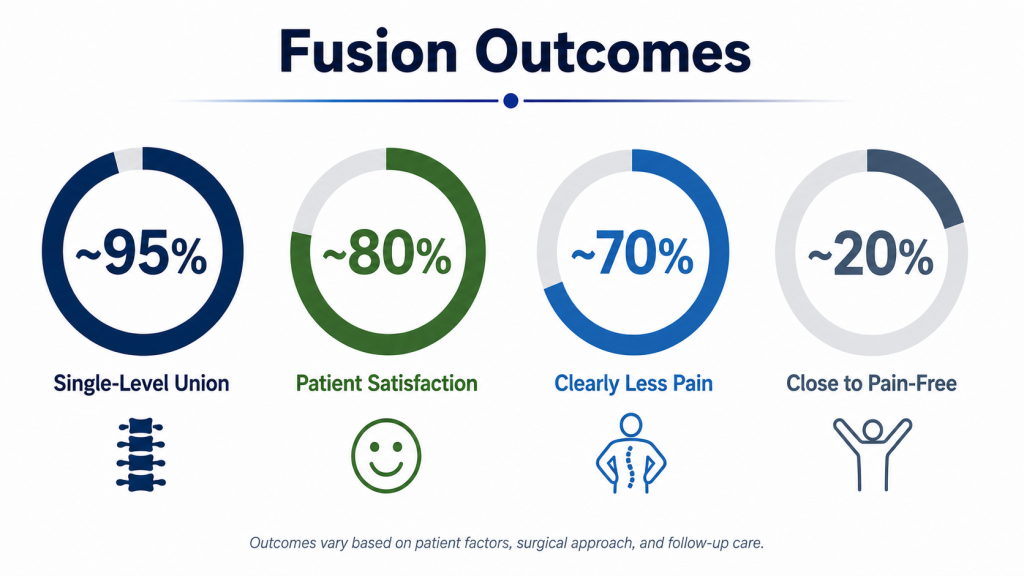
Success depends on two clear metrics: bone fusion and pain relief. So let’s look at the data.
- Bone Healing Timeline
Your body needs time to grow new bone across the graft. Achieving a solid bone union takes 6 to 12 months, and your body is working similarly to how it would heal a broken bone or fracture.
Fusion rates for single-level surgery are high, with studies reporting solid union in around 95% of patients. Nonunion or “failed fusion” becomes more common as the number of operated levels increases, and when surgeons don’t use an intervertebral fusion cage alongside the traditional posterior rods and screws, particularly at the L5-S1 level.
- Clinical Success Rates
The spinal fusion success rate depends on how you measure it. About 80% of patients say they are satisfied after a one- or two level fusion, and around 70% have clearly less pain, though only about 20% end up close to pain-free.
Your diagnosis before surgery is more important than the technique used. Fusion works best for a slipped vertebra or a disc herniation, and least well for back pain with no clear cause on a scan. Fewer levels fused also means better odds. Newer minimally invasive fusion techniques also speed up the recovery process.
- Risk of Pseudarthrosis
Sometimes bones fail to join together properly. Doctors call this non-union, failed fusion or Pseudarthrosis. Scans pick it up in around 8% of single-level fusions, but most cases cause no trouble. Roughly half of people with a non-union on imaging have no symptoms at all, and only around 1% need further surgery to correct it.
This problem happens in a small group of patients. The risk rises if you have weak bones, diabetes, or if you smoke nicotine.
The spinal surgery success rate depends heavily on four factors:
- the number of spine levels fused,
- the surgical technique used,
- your age and bone quality,
- and whether you smoke.
Patients who quit smoking before surgery see notably better fusion rates than active smokers.
Major Trade-Offs of Spinal Fusion Surgery
Fusion solves one problem and creates new considerations. You trade one thing to fix another. We recommend considering this before committing to surgery.
Loss of Flexibility
Once vertebrae fuse, that segment stops moving. You lose natural motion at that point in your spine permanently.
Adjacent Segment Disease
When one segment stops moving, the segments next to it absorb extra stress and motion. Over time, this added load can speed up wear in the discs and facet joints above or below the fusion. This can lead to surgical extension of the fusion over time.
Lumbar Fusion Recovery Time
Recovery starts fast and finishes slow. Most patients can get out of bed and start walking within 1 or 2 days after surgery. Early weeks bring real pain and limited movement, and this should settle steadily. A solid fusion takes 6-12 months, and during that time lifting, bending and twisting should stay restricted, even once the pain has eased and you have returned to light activity. Always remember to ask your surgeon about the recommended recovery protocol for your unique case.
Spondylolisthesis and the Fusion Decision
Spondylolisthesis happens when one vertebra slips forward over the one below it. Mild cases often respond to physical therapy, activity changes, and pain management. Spine fusion becomes the standard recommendation when the slip causes ongoing nerve compression, significant instability, or pain that does not improve with conservative therapies. Your surgeon will grade the slip and check nerve involvement before likely recommending a fusion technique.
Other Effective Surgery Alternatives to Fusion
Fusion may not be your only path forward. Modern care offers options that can fix your back or neck problem while keeping your spine moving naturally.
Artificial Cervical Disc Surgery
Instead of fusing bones, surgeons can remove a damaged neck disc and place an artificial disc. Cervical disc replacement keeps your neck flexible and helps protect nearby discs from extra stress.
Lumbar Motion-Preserving Solutions
Advanced spine centers in Germany offer motion-preserving alternatives to fusion. These include modern artificial disc technologies and facet joint replacement systems that can decompress your spine, replacing the damaged parts without fusing your bones together. Many surgeons refer to decompression surgeries like a discectomy or laminectomy as “motion-preserving surgery”, however removing parts of a joint creates scar tissue and is likely to exacerbate the underlying disc or joint disease, creating greater spine instability over time.
A decompression preserves what’s left, while an advanced implant restores what’s already been lost.
What This Means for Your Health Journey?
A second opinion can make all the difference. Before you commit to any spinal fusion surgery, at home or abroad, you deserve a clear picture of your options: which fusion type fits your case, what your realistic success rate looks like, and whether a motion-preserving alternative is possible for you instead.
At Spine Connection, our team connects you directly with top spine specialists in Germany and Thailand. You get independent medical opinions, clear fixed pricing, and full care coordination from start to finish. You gain access to the most advanced spine technologies without unnecessary waiting lists.
Begin your assessment with our medical team today. Send us your MRI and X-Ray scans to review your options and receive a clear treatment plan from our world renowned spine specialists.
Frequently Asked Questions
How long does lumbar fusion recovery take?
Bone healing takes 6 to 12 months. Most patients walk within days but need several months of rehabilitation before returning to full activity.
What is the difference between TLIF and ALIF?
TLIF approaches the spine from the back and gives direct access to compressed nerves. ALIF approaches from the front through the abdomen and avoids interfering with back muscles.
What is Pseudarthrosis?
Pseudarthrosis means the bone did not fuse solidly after surgery. Risk factors include smoking, diabetes, and low bone density.
Does spinal fusion always mean losing motion?
Yes, at the fused segment. Motion-preserving alternatives like Artificial Disc Replacement and Facet Joint Replacement exist for suitable candidates who want to avoid this trade-off.
Is spondylolisthesis always treated with fusion?
No. Mild slips often respond to therapy first. Fusion is recommended when instability or nerve compression continues despite non-surgical treatment.
Scientific References
- Boonsirikamchai W, Wilartratsami S, Ruangchainikom M, et al. Pseudarthrosis risk factors in lumbar fusion: a systematic review and meta-analysis. BMC Musculoskelet Disord. 2024;25(1):433. Link
- Formica M, Vallerga D, Zanirato A, et al. Fusion rate and influence of surgery-related factors in lumbar interbody arthrodesis for degenerative spine diseases: a meta-analysis and systematic review. Musculoskelet Surg. 2020;104(1):1-15. Link
- Phan K, Thayaparan GK, Mobbs RJ. Anterior lumbar interbody fusion versus transforaminal lumbar interbody fusion – systematic review and meta-analysis. Br J Neurosurg. 2015;29(5):705-711. Link
- Weinstein JN, Lurie JD, Tosteson TD, et al. Surgical versus nonsurgical treatment for lumbar degenerative spondylolisthesis. N Engl J Med. 2007;356(22):2257-2270. Link
- Sears WR, Sergides IG, Kazemi N, et al. Incidence and prevalence of surgery at segments adjacent to a previous posterior lumbar arthrodesis. Spine J. 2011;11(1):11-20.Link

