 Contact Us Today
 Begin My Assessment
 Watch Us On Youtube
 enquiries@spineconnection.org


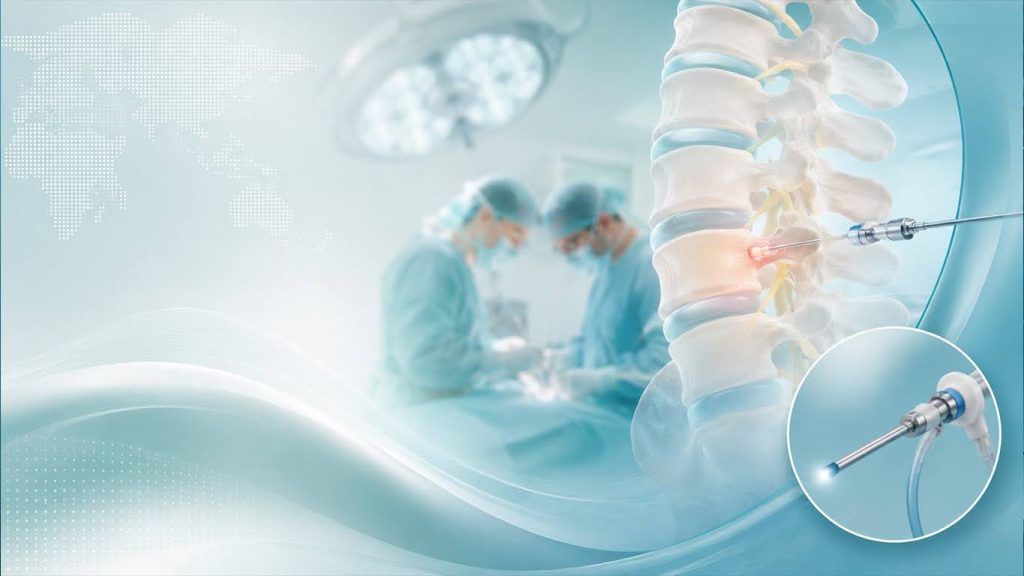
Instead of a large open surgery, endoscopic spine surgery is a minimally invasive operation that treats a damaged disc through a small incision, using a thin camera called an endoscope, along with small instruments.
In modern medical science, endoscopic technology has advanced to the point where practitioners can now access, visualize, and treat many spine conditions previously only accessible through open surgical approaches.
But what does this surgery mean and how can it help a patient in pain? Let us explain what the procedure involves, how it works, and what recovery looks like.
What is Endoscopic Spine Surgery and how is it done?
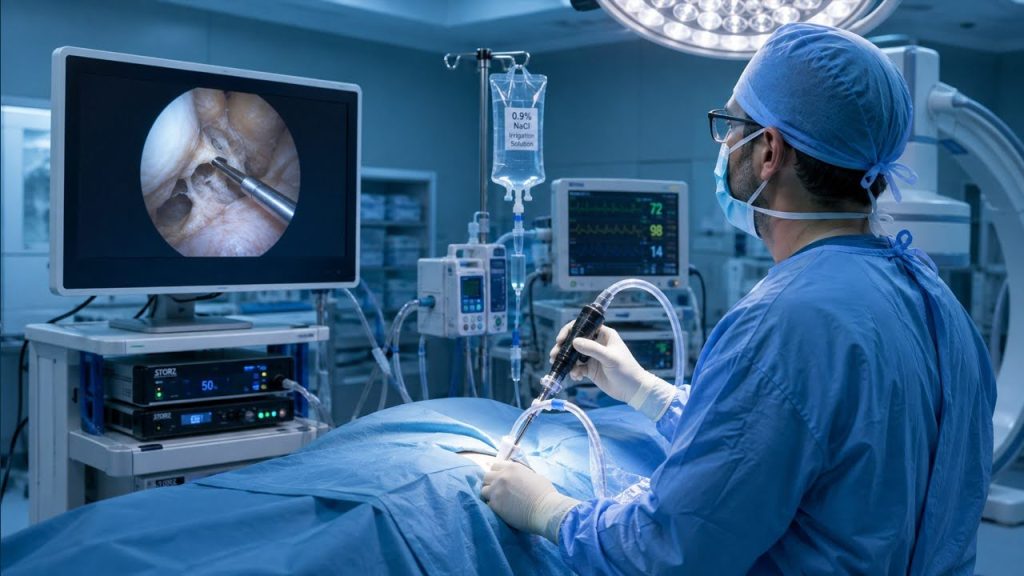
A full-endoscopic discectomy is an outpatient procedure that removes herniated disc fragments through one tiny skin incision. The surgeon inserts a pencil-thin camera tube, thinner than a third of an inch, and works with a high-definition screen instead of a direct view. Continuous water irrigation keeps the surgical field clear the entire time. The goal is simple: take out the tissue fragment pressing on your nerves, and don’t interfere with other soft tissues.
This procedure sits at the far end of minimally invasive spine surgery. Traditional open surgery can cut through bone, muscle and ligaments to reach the spine. Endoscopic spinal surgery reaches the same target through a very small hole and avoids all of the above.
Here is what a complete procedure looks like.
Incision Size and Access
The skin cut measures less than 8 to 10 millimeters, roughly the size of a dime. Surgeons do not open the back. They slide a narrow working channel through this single cut and guide every tool through that same opening.
Transforaminal and Interlaminar Approaches
Surgeons choose between two routes based on where your disc herniation sits.
Transforaminal endoscopic discectomy enters through the neural foramen, the small opening where a nerve root exits the spine. This route works well for disc fragments sitting in or near that foramen.
The interlaminar approach enters between the lamina bones at the back of the spine. Surgeons use this route when the fragment sits closer to the center of the spinal canal.
Your surgeon picks the approach based on your MRI and spine images, not personal preference.
Visualization Without Open Surgery
Instead of an operating microscope and an open field, the surgeon watches a screen fed by the endoscopic camera. Constant fluid flow washes away debris and keeps the view sharp. This setup lets the surgeon work with precision in a space smaller than a coin.
Anesthesia and Staying Awake
Full endoscopic procedures can be performed awake and sedated under local anaesthesia or asleep with general anaesthesia. Your surgical team will confirm the approach that suits your case. Local anaesthesia is often preferred where suitable, as it carries lower systemic risk and supports faster recovery after surgery.
Why Endoscopic Surgery Beats the Traditional Route?
Endoscopic spine surgery is a form of keyhole spine surgery. It offers clear physical benefits compared to older “open surgery” methods. Here are the benefits below.
Your Back Muscles Stay Intact
Surgeons gently dilate the muscle instead of cutting or stripping it off the bone. Less muscle damage means less pain after surgery and a faster return to normal movement.
Minimal Blood Loss
The small incision and precise technique keep tissue trauma low. Most patients lose almost no blood during the procedure.
Faster Recovery
Most patients are able to walk the same day and are often discharged within 24 hours, though timing varies based on individual case and anaesthesia recovery. Compare this with open spine surgery, which often keeps patients in the hospital for days. Faster mobility after endoscopic surgery also means a quicker return to work and daily activities.
Scarring Stays Minimal
A single small cut leaves a small cosmetic scar outside your body. Just as important, the technique limits scar tissue formation inside the spinal canal, which can lower your risk of ongoing pain from internal scarring later.
Sciatica and pinched nerve pain usually come from a disc fragment pressing on a nerve root. Full-endoscopic surgery targets that exact fragment and removes it directly. Patients with leg pain, numbness, or weakness from a herniated disc are often good candidates once conservative treatment fails to bring relief, or if there’s a serious chance for permanent nerve damage.
Important Risks and Limitations
Every surgical operation carries specific risks, including minimally invasive procedures.
Potential Medical Complications
- The most common is that the disc herniates again at the same level, or a fragment is left behind. Either of these can require a second procedure, or more complete operation such as Artificial Disc Replacement or Spine Fusion.
- Less often, the thin membrane that covers the nerves (the dura) can be torn, or a nerve root can be irritated or injured.
- Infection and significant bleeding are both rare, each in well under 1% of cases, lower than with open surgery.
- Lower Back Pain can remain: If the disc has a marked loss of disc height and is dehydrated and dysfunctional, an endoscopic discectomy can fix nerve pain in the leg, but it likely won’t fix the lower back pain.
When endoscopic surgery isn’t the answer?
Endoscopic discectomy is precise but narrow in scope. It removes a small disc fragment pressing on a nerve, and that is all. Several spine conditions may need a different operation. For example, a large, hardened or calcified disc can be too solid to remove through the endoscope and may need open decompression. In cases of instability, such as spondylolisthesis (slipped vertebra), or a deformity like scoliosis, endoscopic surgery can only help temporarily to free nerve pathways, but a larger surgery such as a fusion is often required to stabilize the spine and prevent further deterioration.
Why Patients Travel Abroad for This Surgery?
Access to true endoscopic spine surgery is not guaranteed, and the different medical terms used can cause confusion. Patients in countries with modern healthcare systems like Australia, the UK and across Europe are sometimes told they are booked for a “minimally invasive” decompression, only to find the operation involves a larger incision, more bone and muscle removed, and a longer recovery than expected. The term “minimally invasive” covers a range of techniques, and full-endoscopic surgery, done through a keyhole incision, is the least invasive of them.
Not every surgeon who offers minimally invasive surgery performs the genuine keyhole version, so it’s worth asking your surgeon directly whether they are offering a full endoscopic technique, how often they perform it, and what size incision and recovery to expect. The answers will tell you a great deal.
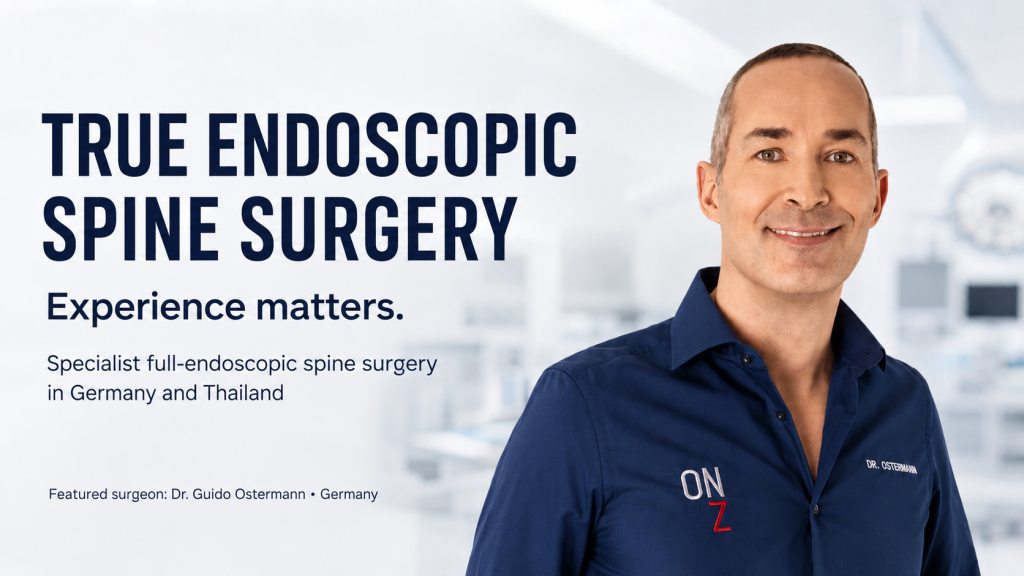
Endoscopic spine surgery is a speciality in its own right, and the skill comes from doing it often. This is the real reason patients travel: to reach surgeons who perform these procedures routinely rather than occasionally. In Germany, Dr. Guido Ostermann is renowned for the Joimax Tessys endoscopic method. In Thailand, Dr. Tayard Buranakarl and Dr. Porameth Charoentanakorn also use full-endoscopic techniques. For the right patient, being operated on by an experienced surgeon who performs this every week outweighs almost any other factor.
Access is the other reason. Where at home patients might be waiting for months to consult with a spine specialist, an assessment with one of the above surgeons can usually be arranged within 2-3 weeks, with the cost agreed clearly and upfront, so you know the full figure before you commit to anything.
Your Next Step
Living with sciatica while you wait for a specialist slot helps no one, least of all you. If a herniated disc is behind your pain, you deserve a straight answer on whether endoscopic spine surgery fits your case, what recovery genuinely looks like, and what your treatment will cost from the first consultation to the final follow-up.
Our team at Spine Connection connects you with experienced endoscopic spine surgeons in Germany and Thailand, with multiple independent opinions and no waiting lists. Ask Our Doctors what your options look like. Upload your recent MRI scans now to get your personalized treatment plan and start your journey toward a healthy active lifestyle.
Frequently Asked Questions
How long does herniated disc surgery recovery take with the endoscopic method?
Most patients walk the same day and return to light activity within one to two weeks. Full recovery varies by case, and you should check with your surgeon.
What is the difference between transforaminal and interlaminar endoscopic discectomy?
Transforaminal enters through the neural foramen at the side of the spine. Interlaminar enters between the lamina bones at the back. Your surgeon picks the route based on where your disc fragment sits.
Is endoscopic spine surgery the same as keyhole spine surgery?
Yes. Keyhole spine surgery is just the everyday name for the same operation, done through a small camera and a keyhole sized incision. “Keyhole” and “minimally invasive” are broad terms that cover many techniques, so it’s best to ask your surgeon whether your procedure is specifically full-endoscopic, not just “keyhole”.
Can this procedure treat sciatica and pinched nerve pain?
Yes, when the cause is a herniated disc fragment pressing on a nerve root. A specialist review of your case, including MRI, confirms whether you qualify.
Why do patients travel to Germany for this surgery?
Germany offers deep surgical experience in full-endoscopic techniques, shorter wait times than many public systems, and fixed pricing agreed before treatment.
Scientific References
-
- Ruetten S, Komp M, Merk H, Godolias G. Full-endoscopic interlaminar and transforaminal lumbar discectomy versus conventional microsurgical technique: a prospective, randomized, controlled study. Spine (Phila Pa 1976). 2008;33(9):931-939. Link
- Yong JH, Wang E, Chin BZ, Hey HWD. Full-endoscopic versus microscopic lumbar discectomy for lumbar disc herniation: a systematic review and meta-analysis of 4,186 cases. Spine J. 2026 (online ahead of print). Link
- Yang CC, Chen CM, Lin MH, Huang WC, Lee MH, Kim JS, Chen KT. Complications of Full-Endoscopic Lumbar Discectomy versus Open Lumbar Microdiscectomy: A Systematic Review and Meta-Analysis. World Neurosurg. 2022;168:333-348.Link
- Phan K, Xu J, Schultz K, Alvi MA, Lu VM, Kerezoudis P, Maloney PR, Murphy ME, Mobbs RJ, Bydon M. Full-endoscopic versus micro-endoscopic and open discectomy: A systematic review and meta-analysis of outcomes and complications. Clin Neurol Neurosurg. 2017;154:1-12.Link

