 Contact Us Today
 Begin My Assessment
 Watch Us On Youtube
 enquiries@spineconnection.org



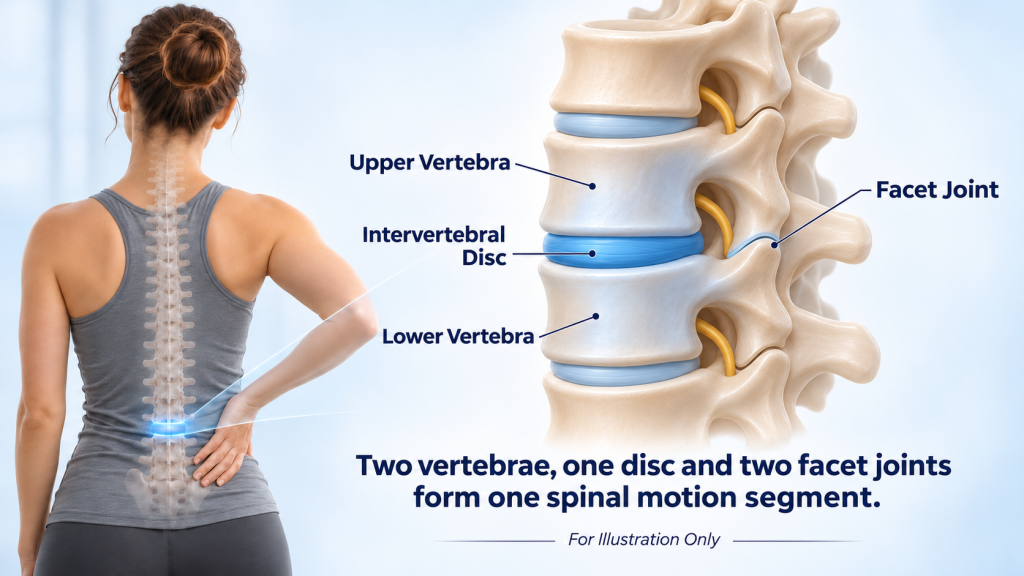
If your spine surgeon says a level of your spine is damaged and surgery is recommended, they might talk about different treatments including fusion, disc replacement, facet replacement or dynamic stabilisation. Each choice sounds like a big decision, and each affects how your back moves after the surgery.
There are seven spinal motion segments in your neck, and five in your lower back. Other than the C1-C2 segment at the very top of your neck, each segment includes two nearby vertebrae, the disc between them, small joints at the back, and supporting tissues. These parts share the work of carrying weight and guiding movement. When one part becomes damaged, the whole segment might suffer. When you understand this unit, you can compare treatments with confidence.
Spine Connection focuses on preserving healthy movement whenever your condition allows. Moreover, let’s learn about your motion segments so you can compare your options to protect your mobility for years to come.
The Parts of a Spinal Motion Segment
A spine motion segment acts as one of many that works together in your spine. Each functional spinal unit contains specific parts that work together to keep you upright and active
- Two adjacent vertebrae: These solid bone blocks stack on top of each other to form the main column of your spine. They carry your body weight and protect your nerves.
- Intervertebral disc: A shock-absorbing cushion sits directly between the two bone blocks. This disc features a tough outer ring called the annulus fibrosus and a gel-like center called the nucleus pulposus.
- Two facet joints: These small, paired joints sit at the back of the bone blocks. They guide your movements and stop your back from twisting too far.
- Supporting tissues: Strong ligaments and muscles wrap around the segment. They hold the bones together while providing stability against pulling and twisting.
The intervertebral disc holds the vertebrae together and absorbs heavy shock when you walk, run, or jump. At the same time, the disc helps the segment bend and tilt in controlled directions. The facet joints act as steady guides. They limit excess movement so your joints slide smoothly without grinding. Every single part plays a vital role in keeping your spine balanced, flexible, and pain-free.
How the Disc and Facet Joints Work Together?
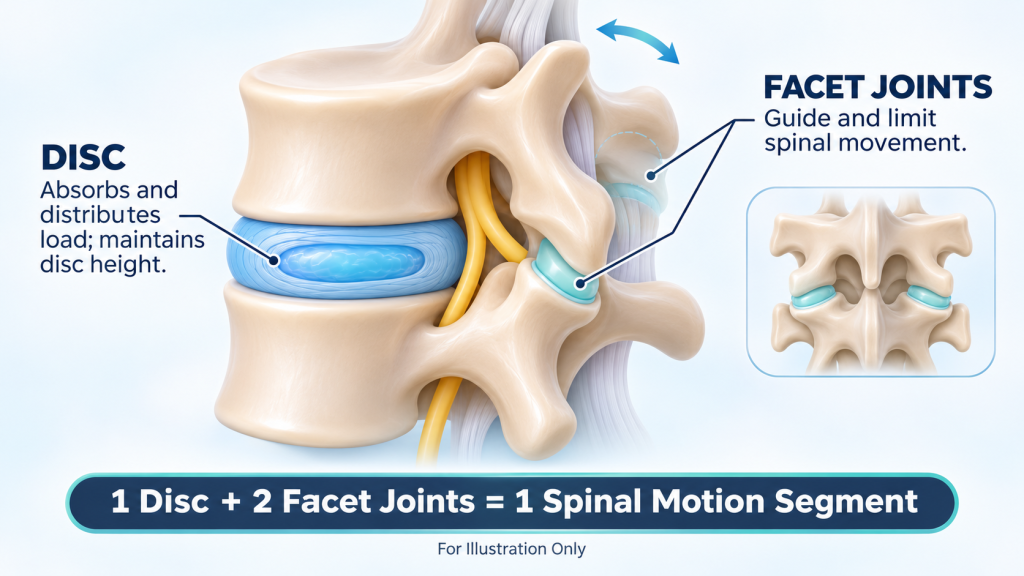
The disc and facet joints together work as one system. The disc carries load and absorbs shock at the front of the segment. The facet joints guide movement at the back. Each part shares the work, so neither carries the full load.
In the lower back, the facet joints also protect against shear, flexion, and rotation forces. Shear slides one vertebra over the next. Flexion bends the spine forward. Rotation twists the spine. Healthy facets keep these forces within safe limits.
Damage to a spinal disc affects the facet joints and vice versa. A worn or degenerative disc loses height, and the vertebrae become closer together. Over time, the facets joints become misaligned and grind instead of glide, which causes arthritis. Facet damage also changes how the disc moves, which adds stress to the disc.
Both structures can become painful from injury or from wear and tear over time. Two common conditions result.
- Degenerative Disc Disease is the wearing down of the disc.
- Facet Arthropathy is the wearing down and arthritis of the facet joints.
Patients often have both at the same level. Pain often spreads to your hips and legs when a damaged disc presses on a nerve. Scans show both structures clearly, so your specialists check them together. This is why your specialists review the whole segment, not the disc alone.
When a Segment Becomes Painful?
Pain in one segment affects daily life. You sit, sleep, and walk with less comfort. Pain comes primarily from one of three sources:
- The disc: A torn outer ring, a bulging center, or a dehydrated disc causes sharp local pain or burning nerve pain down your leg.
- The facet joints: Inflammation, worn cartilage, or arthritis in these small rear joints causes deep aching pain when you bend backward or turn.
- Both structures: Advanced wear and tear can damage the disc and the facet joints at the same spine level simultaneously.
The first step is finding the source. Your specialists use your symptoms, exam, and scans to find the source. Each source needs a different plan. For example, disc pain often hurts when you sit or bend forward, while facet pain often hurts when you lean back or twist. Only a specialist review and diagnostic testing can confirm the source.
Doctors usually begin with conservative care. This includes physical therapy, gentle exercise, and pain injections. Many patients gain real relief without surgery. Doctors often ask you to try these steps for six to twelve months.
Severe or worsening nerve symptoms need urgent care. Surgery also fits when pain, nerve pressure, or instability stays after conservative care and affects your quality of life. Your surgeon picks a plan with a goal to help solve the problem, relieve symptoms, prevent further deterioration, and preserve motion if possible.
A clear diagnosis gives you control. Do not wait in pain with no answer. Spine Connection specialists in Germany and Thailand review your scans and symptoms and explain your choices in clear terms.
Why Segment Health Shapes Treatment Choices?
Every treatment acts on a vertebral segment in a different way:
- Spinal Fusion locks two vertebrae together using bone grafts and hardware. This stops all movement at the segment to end pain.
- Artificial Disc Replacement replaces a worn disc with a modern implant. This restores original disc height and maintains natural movement.
- Facet Replacement replaces worn back joints with smooth implants when disc replacement alone cannot solve joint arthritis.
- Dynamic Stabilisation uses flexible rods to stabilize a weak segment while keeping controlled movement.
The condition of the whole segment decides which motion-preserving alternatives to fusion fit. Healthy facet joints and good alignment favour ADR. Damaged facets point toward facet replacement. An unstable segment needs support, so dynamic stabilisation fits selected cases. Some segments need fusion for support and height.
Spine Connection helps patients obtain independent opinions from experienced neurosurgeons and orthopaedic spine specialists. This approach gives specialists an opportunity to assess the disc, facet joints, spinal stability, alignment, and previous treatment together.
Send Your Scans for Specialist Assessment
Your spinal motion segments carry you through every step, twist, and bend of your life. When pain strikes, fixing your back does not have to mean locking your spine in place. By understanding how your discs and facet joints work together, you can choose care that protects your natural motion.
Or you can send your MRI, CT, or X-ray scans and medical records to Spine Connection. Our partner specialists from leading German and Thai hospitals review them thoroughly. With independent medical opinions, you gain a clearer understanding of the problem, the treatments suited to your condition, and whether motion-preserving surgery deserves consideration.
If treatment in Germany or Thailand suits your needs, our team helps coordinate the next steps, including available package details, travel support, and rehabilitation arrangements. Request your assessment now and learn which treatment best fits your spine.
FAQs
What is a spinal motion segment?
A spine motion segment is two neighbouring vertebrae, the disc between them, two facet joints, and the ligaments holding them together.
Which part of my segment causes my pain?
Your specialists find the source with your symptoms, exam, and scans. Pain comes from the disc, the facet joints, or both.
Do I always need a fusion?
No. Fusion is the safer choice for some segments. Others suit disc replacement, facet replacement, or dynamic stabilisation. A specialist review shows which group you fit.
How do I compare treatments in Germany or Thailand?
Send your MRI, CT, and X-ray scans to Spine Connection. Independent specialists review them, and your concierge guides each step.

