 Contact Us Today
 Begin My Assessment
 Watch Us On Youtube
 enquiries@spineconnection.org



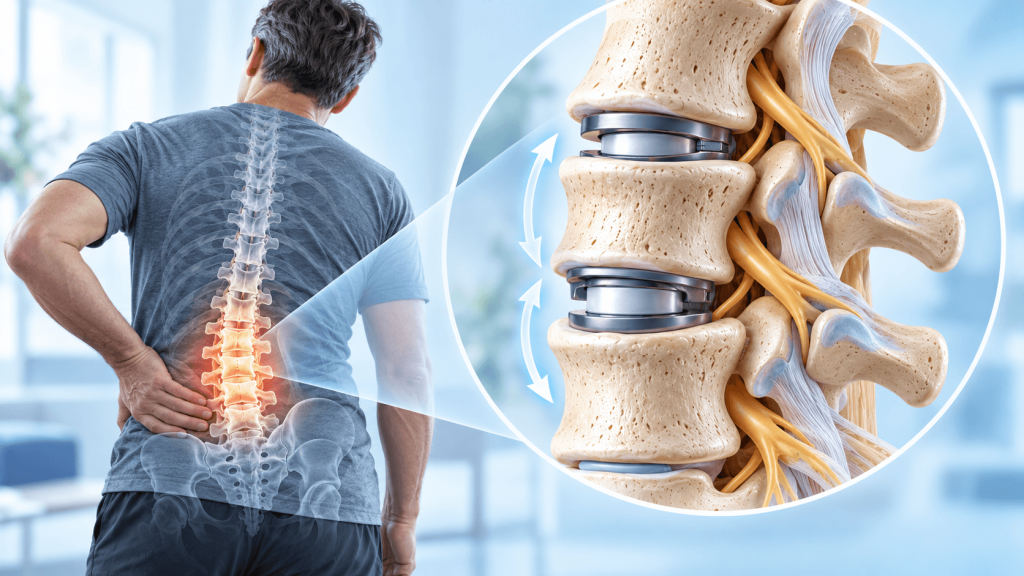
Your back hurts in more than one spot, and every day feels harder. Your surgeon at home suggests a fusion across several levels. A fusion joins bones together so they no longer move.
But fusion is not the only option for every patient. Multilevel disc replacement is a treatment that may help suitable patients relieve pain while keeping controlled movement in the spine. Artificial Disc Replacement (ADR), also called Total Disc Replacement (TDR), is another option.
Discs sit between the bones of your spine and absorb shock. In ADR, the surgeon removes a damaged disc and puts in an artificial disc. The surgery has two goals: restore disc height and keep or restore controlled movement. Many patients ask if surgeons replace several discs in one surgery.
For carefully selected patients, multi-level artificial disc and facet joint replacement is an option. Spine Connection specialists in Germany review your case and tell you if multi-level ADR fits your spine.
How Multi-Level Disc Replacement Works?
Your spine is a column of bones called vertebrae, with a spinal disc sitting in between them. The disc holds the bones together, absorbs shock, and lets your spine bend and twist in controlled ways. A worn disc causes pain and sometimes presses on a nerve.
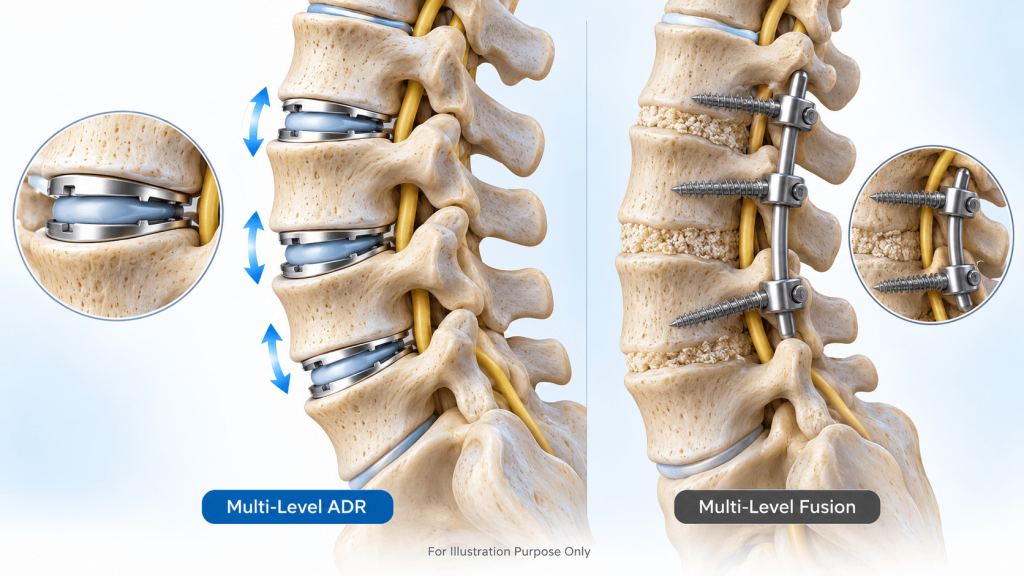
In ADR, the surgeon removes your damaged disc completely. Then the surgeon places an artificial disc in the same space. This restores healthy height and movement.
Surgeons commonly reach your spine from the front, through the abdominal cavity. Doctors call this the anterior approach. Sometimes the surgeon uses the lateral approach, from the side. Many fusions use the posterior approach, from the back. The front route is generally less traumatic for you because the surgeon avoids cutting important muscles in your back.
For suitable patients, ADR achieves the same goals as fusion:
- Decompresses your nerves, which takes pressure off them
- Restores healthy disc height
Unlike fusion, ADR also keeps natural controlled movement. Fusion locks one bone to the next, so each fused level stops moving. More fused levels mean less movement. The levels above and below then carry extra stress, which can lead to what Doctors call “post-fusion adjacent segment disease.”
ADR keeps controlled movement at each treated level, which matters most when more than one level needs treatment. Movement matters especially for patients in their 20s, 30s, and 40s, and for active people who enjoy sports and the outdoors.
Why Implant Design Matters for Multiple Levels
Artificial discs are not all the same. Older generations include ball-and-socket-style discs. Newer-generation discs copy the movement of a natural disc more closely. They can offer six degrees of movement, including vertical compression, which is the up-and-down squeeze of the spine and gives you shock absorption.
Resistance also builds toward the end of every movement. This keeps motion controlled, not excessive. Controlled motion protects your facet joints. Facet joints are two small joints at the back of every level, and they guide and limit your movement. This protection allows safer multi-level use in suitable patients.
Design matters more with several levels. Each disc shares load and movement with the levels around the disc. A poor match at one level adds stress to the next.
Spine Connection specialists have experience with multiple implant models, including the most studied devices worldwide:
- Four lumbar models
- Five cervical models
- Hybrid construct spine surgery
Every patient has a different spine, so one standard implant rarely fits everyone. Your surgeon chooses the optimal disc for your unique case and anatomy. Specialists keep these models in a sterile inventory room next to the operating theatre, so your team has each option ready. Ask your surgeon which implant fits each level and why. Your team reviews your scans before surgery and confirms the plan.
People Who Are Suitable For Multi-Level ADR
Having two or more damaged discs does not automatically make you suitable for multi-level ADR. Your specialist needs to assess your overall spinal health and the cause of your symptoms.
The assessment usually considers:
- Disc damage and the number of affected levels.
- Spinal alignment, including any vertebral slippage.
- Facet joints, which connect the small bones at the back of your spine.
- Bone health and the ability of your bones to support an implant.
- Previous spinal surgery.
- Your symptoms, medical history, and activity needs.
Younger and active patients often have a strong interest in keeping movement, with many hoping to return to sport and outdoor life without limits on spine mobility. Still, age alone does not decide your plan.
Some patients are not suitable for two, three or even four-level artificial disc replacement surgery. Examples include scarring in the abdomen, a vertebra slipping out of position, or badly damaged facet joints. These are just some examples, and your highly experienced ADR Surgeon checks every factor before they advise you.
When ADR is not suitable, Total Lumbar Facet Replacement is an alternative for some patients. Surgeons remove the damaged facet joints through the back and replace them with artificial joints. This restores the correct position of the vertebra and keeps healthy movement. Some spines still need fusion, and your specialists tell you when.
Every spine is different and Spine Connection arranges an individual assessment. Independent specialists review your scans and explain which option fits your spine and why. A second opinion shows you the full list of options, so you can compare opinions and choose with confidence. Spine Connection treats fusion as a last line of defence, for cases where a motion restoration spine surgery is not available.
Real Stories That Reflect Long-Term Outcomes
Patient stories offer useful insight into life after multi-level artificial disc replacement. They also show why individual results matter.
Joel, Craig, and Jeff travelled to Germany for two-level lumbar ADR. Their stories describe active lives nine and ten years after surgery, with activities such as skiing, windsurfing, and flying.
- Joel returned to skiing, training, and other activities with his family.
- Craig, who had suffered from lower back pain for years, reported an active lifestyle ten years after surgery.
- Jeff, a commercial airline pilot from New Zealand, underwent two-level cervical disc replacement after a double fusion was offered as his surgical option at home. Years later, he was still flying and sharing his experience with other patients.
These accounts show what individual patients experienced. They do not guarantee the same outcome for every person. Results depend on factors such as your health, the extent of spinal damage, the chosen procedure, surgical experience, and commitment to rehabilitation.
Spine Connection works with experienced spine specialists at ONZ International in Germany and helps patients coordinate their treatment journey. German treatment packages offer fixed pricing for included medical and rehabilitation costs, with the exact package confirmed after case assessment. Rehabilitation support at Europe’s largest rehab center also helps patients work towards their recovery goals.
If you are comparing spinal fusion with multilevel ADR candidacy, these patient experiences offer useful context. Your own specialist assessment should guide the final decision.
Take the Next Step Towards a Clearer Treatment Plan
You deserve to understand your options before choosing spinal surgery. Send your medical records and scans our specialists for a detailed review. They will assess whether multi-level disc replacement suits your condition or whether another procedure deserves consideration.
At Spine Connection, we help international patients access experienced spine specialists, compare independent medical opinions, and coordinate treatment in Germany. Fixed-price packages and rehabilitation arrangements also help you plan the practical parts of treatment.
Select Begin My Assessment or Ask Our Doctors. Your spine is unique, so your answer is too. We assess suitability for you alone, never with a blanket recommendation.
Frequently Asked Questions
What does multi-level disc replacement mean?
Multi-level means more than one disc. Surgeons remove two or more damaged discs and replace each with an artificial disc. The goals are restored disc height and controlled movement.
How many discs does a surgeon replace at once?
Suitability decides, not the number alone. Patient stories on our site include multi-level cases, with some patients receiving up to 4 new discs in their neck, and also in their lower back.
How does multi-level disc replacement differ from fusion?
Both take pressure off nerves and restore height. Fusion removes movement, while ADR keeps controlled movement. Some spines still need fusion.
Who is not suitable for multi-level disc replacement?
Examples include scarring in the abdomen, a vertebra slipping out of position, or badly damaged facet joints. Total Lumbar Facet Replacement is an alternative for some of these patients.

